Search This Blog

Monday, November 10, 2014

Best Reads of 2013 (Only 8 this year. Sigh.)

Oh my goodness. This weekend I read a couple of books I wanted to record for my 2014 favourites list. And when I opened my Blogger account, I realized I had never completed and posted my 2013 list! Here it is at last! All ready to go, and just waiting there, in the interwebs, alone and unloved.

Somehow, 2013 was not a brilliant year for reading, but there were a few good ones:

I read a few must-reads, and found them formulaic. Step forward:


David Levithan for Every Day


and Rainbow Rowell for Eleanor and Park.


These two books actually made me realize that the teen-age-outsider-romance genre is offically over-mined. The books can be cute and readable. Most YA fiction is strong on plot and character, and goes down easily, but, like hamburgers compared to filet, often wolfed in a hurry; cheap, but even at the price still too many calories for the nourishment provided.


I read a book I expected to be formulaic, and actually copied a quotation to carry around in my device: Step up Anne Tyler for
Back When We Were Grown-ups.


I've written separately about my fabulous Tudor moment this summer, featuring, in part, Wolf Hall and Bring up the Bodies by Hilary Mantel, 


and, Namesake by Sue McLeod (in YA, from Pajama Press, a little starlet of Canadian publishing). All great books that make this list.


I did find two graphic efforts quite superior to almost anything I've ever read in the category:


Laika by Nick Abadzis, from 1st Second–possibly the best graphic publishing house on earth. Laika is a fictionalized, graphicized version of the Soviet space program sending Laika the dog into space. Real characters and timelines. Graphic images that brought an extra dimension to the story that words could not. Not exactly beautiful, but SENSATIONAL. I cried through most of the book. My kids cried through most of the book.


Relish by Lucy Knisley is the second graphic memoir by Knisley. I also enjoyed her first, French Milk, and I have actually been reading graphic memoirs, and feel ready to judge among them. Her works are deft and engaging and suitable for the treatment.


I must mention that in my hall of fame as the one of best graphic works ever and best graphic memoir in particular, is Marisa Acocella's Cancer Vixen. So harsh and funny. And heart-breaking and funny. And gross and funny.


Staying with memoirs, one of my real favourite reads of this year, altho it took two tries to get it going, was Maphead: Charting the Wide, Weird World of Geography Wonks, by Ken Jennings. He is the guy who at one point had won the most money ever on Jeopardy. (Should I mention that my scrabble-master spouse and I have a secret plan, if we ever need money fast, that we will go to California, and he will go on Wheel of Fortune, and I will go on Jeopardy? No, uh, best keep it secret. Never mind. You remember nothing! *Waves hands spookily*) Jennings was also chosen to play against IBM's computer, Watson, and I realized that I really liked him when underneath his response during Final Jeopardy he wrote on his screen "I for one welcome our new computer overlords". In any case, as a slight geography wonk myself (surprised?) I loved reading all the way people indulge this passion, and I find myself relating stories from the book quite often. His writing style is so engaging, and he is so smart, but also so keyed to pop culture, that it was one of those reading experiences that are like talking to a great friend.


Over the past couple of years I have read a bunch, but a bunch, of laddish science fiction books. I think it is a kind of mini-genre. I found them funny at first, but they were so sophomoric, that despite a certain shock value–which is a quality I often go for–they became boring and many I could not be bothered to finish reading.  I find my buddy Shelf Monkey has recommendations on LibraryThing for these books, one of which actually made it onto the list of best reads:

Charles Yu's How to Live Safely in a Science Fictional Universe, a super-fun story about how it is grammar which defines past and future, and therefore time travel is all about altering grammatical settings! Wow! Fun! I know, right? Love it!


On the list of laddish also-rans that still might be worth considering we have:

Corey Doctorow's The Rapture of the Nerds:A tale of the singularity, posthumanity, and awkward social situations.
I did abandon this book part way through. Love him so much I might get back to it.


Mark Leynor's Sugar Frosted Nutsack: A Novel. Just about unreadable.

David Wong's John Dies at the End
I did read it all. Apparently also coming as a major motion picture. Or something.


And that's it. The year that was.

The marigold does wonder nervously if all reading will become graphic at some point...?

Sunday, March 9, 2014

Venice books


Iago
David Snodin
Henry Holt and Co
2012


Scherzo
Jim Williams
Marble City Publishing
2013


As usual reading seems to come in clumps. Right now, it’s a Venice moment and I am having the kind of immersion experience that I particularly enjoy. (FYI: up next: a Huron-Wendat moment, featuring Joseph Boyden's The Orenda.)

Like all people in love with culture, I consider Venice a high point. I have spent a lot of time just down the same coast. I speak Italian reasonably well, altho the Venetian dialect is actually impenetrable to me. I was last in Venice a couple of years ago with my kids. We saw a little of the biennale. Yes! We happened to be there on a rainy and therefore deserted summer evening. We took advantage of the opportunity to take a gondola ride minus the usual crowds. It was very dark, very quiet, and quite grim. We saw rats down an alley tearing at the garbage. It was a rare moment that allowed us to get a glimpse of pre-20th century Venice, and proved to be very useful visual background for novels about historical Venice. 

This year one of my kids studied Othello, really The Tragedy of Othello, the Moor of Venice

John Edward McCullough plays Othello, 1878. 
Lithograph by Forbes Co., Boston & N.Y. Public domain.
(Isn't this delicious?)


It is a gap in my Shakespeare, never seen the play, or read it, or studied it, haven't even seen the opera. Luckily I know enough to get started talking about it. (Thanks to Pierre Bayard's  How to Talk About Books You Haven’t Read for letting me feel comfortable saying that. I talk about his book all the time. Altho I did read it. Well, most of it.)


To get some background, I had a look at the essay on Othello in Harold Bloom's book Shakespeare: The Invention of the Human. (Bloom is my god of reading.) 


It was the perfect moment to get out a birthday gift, Iago by David Snodin, and start reading it. Then in an accident of timing I also found myself reading, for a LibraryThing early review, Scherzo: a Venetian Entertainment by Jim Williams

Of course one should expect to encounter the same family names in books involving Venetian aristocrats, especially in Council of Ten characters, which is happening even tho these stories are set about a century apart, and provides a kind of shivery historical depth to the characters in both.

But beyond the similarities in the setting and glimpses at the source language and culture there are additional elements in common between the two books. And maybe something about Venice is…fractal?…in a way that led both writers to choose an epistolary narrative style with multiple voices. 

I'll start with Iago, because I had chosen it for myself at the bookstore, and I started reading it first. 

So, Snodin is a respected producer of Shakespeare and Dickens and Austen for the BBC with a big attractive hardcover offering, but I found the book slightly...wrong.  I can't help mentioning that it is LARDED with Italian, practically every instance of dialogue has an Italian word or phrase inserted, many of them fairly obscure, and altho I had to look up a few to verify their accuracy, I found few errors. Very scholarly. On the other hand, THE PLACE NAMES ARE ALL IN ENGLISH. What? Wouldn’t that have been the first step in bringing English-language readers into Italy?

Harold Bloom begins his essay on Othello in Shakeshpeare, The Invention of the Human, by showing why in the 20th century Iago's story has eclipsed the "Tragegy of Othello". Snodin gets that, and loves Iago as a character. He wrote a little piece in the Huffington Post called The Best Villain Ever about his inspiration. The funnest thing in the article is that if it wouldn’t typecast him (hmmm - there’s a pun there…) he would love to do a similar extension on Edmund and Goneril from King Lear. The hint that would take him away on a Goneril journey is jaw-dropping. Actually! I would love to read it!

The book moves ploddingly, but is not uninteresting. I kept reading it, but boy! is it a little too long and repetitive. The opposite of what I would expect from a TV background, but I suspect Snodin wanted to make his erudition clear.

At the other end of the (marketing) spectrum, Scherzo is an ebook reissue, seemingly with a limited distribution budget and yet his is the book I wanted to get back to whenever I found a moment. (Actually Williams laughingly mentions that his publisher nominated the book for the Booker prize, which only goes to show that he did not expect it to be successful.)  Williams has provided a great flavour of the city, and an additional sense of the movement of polyglots around the European capitals in the 18thC. Scherzo has a judicious number of Italian words liberally sprinkled throughout and also quite a number of words and phrases in Latin and Greek, glossed for the reader within the narrative. I noted a few of them as keepers. All in all, handled much more naturally, with word play and translation intrinsically important, rather than  as foreign words appearing salted on top of the story. (Or maybe I should say appearing like undigestible flaxseeds rather than salt.)

Side note on tech: it was a great advantage to read Scherzo as an ebook. I could highlight and make marginal notes, but instead of having to search by rifling thru pages, in an ebook (I use the Kindle app across a number of devices) you can tap a button and see all your highlights and notes in a lovely list. There is also a way to save your notes to Evernote, where they could be filed and tagged usefully. I still have to actually implement it, but I have gotten as far as looking up the instructions. 

Williams has also written an essay about his inspirationIn Writing Whodunnits, Notes on writing Murder Mysteries he says:
I have no general theory about writing murder mysteries, but however one divides the genre, there seem to be three possible foci for the narrative. The first is the identification of the murderer along with resolution of ancillary mysteries such as the exact method, place and timing of the murder. The second is the process of detection itself, whether through exploration of the character of the detective, or police procedures and forensic science. The third is the background leading to the murder, which means an investigation of the psychology of the murderer or the dynamics of a set of relationships that will lead to the murder. These three approaches aren't mutually exclusive, but any novel will tend to emphasize one of them.

Williams places Scherzo mainly in the third category, which is the particular sub genre he favours. I have written before about genre fulfillment, and here is a lovely statement about how to judge it by John Cawelti in Adventure, Mystery, and Romance: Formula Stories as Art and Popular Culture. In his chapter The Study of Literary Formulas he says:
 …we can evaluate the works in two different ways: a) by the way in which they fulfill or fail to fulfill the full artistic effect of that particular type of construction… [and]…b) the way in which the individual work deviates from the flat standard of the genre to accomplish some unique individual expression or effect.

This is the way snobby elitist readers, such as I, read genre fiction: looking for genre thrills rather than literature. With these two books we are actually in genre-mash-up territory–historical/foreign/mysteries. Scherzo succeeds wildly. Iago was fine. A lover of Venice or mysteries could enjoy either book. A lover of reading and writing would really enjoy Scherzo

Bonus recommendation on the history of Venice:
The Venetian Empire: A Sea Voyage by Jan Morris
This book is credited in the bibliography of Iago, and it is wonderful and while not actually about Othello, is about the empire that employed him as governor of Crete.


Bonus recommendation:
The City of Falling Angels
by John Berrendt
An investigation into the fire that destroyed Venice's famous La Fenice theatre and the (corrupt) rebuilding process.  Very very readable. Accords with what I know about managing things in Italy.
Berendt also wrote Midnight in the Garden of Good and Evil.


You can also think about:
Thomas Mann's Death in Venice (and OH! I think I'll rewatch the movie myself right now.)

Henry James wrote about and lived in Venice for some time.

So did Ezra Pound. Ezra Pound's mistress, Olga Rudge discovered and publicized hundreds (!) of Vivaldi concertos which had either been lost or forgotten, and she and Pound were the advocates of his music in Venice that reestablished his fame.

Jane Turner Rylands is married to the director of the Guggenheim in Venice, and has written contemporary short stories about the city.

Finally, I really enjoyed Carnevale by MR Lovric and A Venetian Affair by Andrea di RobilantCornelia Funke set The Thief Lord in Venice and Donna Leon has a famous (so-so) series of detective stories set in Venice.

Finally, sadly not yet translated into English, is Tiziano Scarpa's Strega prize-winning Stabat Mater about Vivaldi and the Conservatorio dell'Ospedale della Pietà, a girls' orphanage. So tragically beautiful, just like Venice itself.

Friday, October 25, 2013

Pinterest is the new Vogue, or How I Spent My Summer Vacation


                               VS


For a long time I have wondered about fashion and magazines and reading time and beautiful photography and prices and old media versus social media and also what to wear today. All these concerns intersect in my world.

So - for starters, if you are reading books, you don't have time to read magazines and vice versa. That's hard for me, right there.


Then, the fancy fashion magazines are great for photography, but don't really help you decide what kind of shoes to get this fall, and when they do indicate what kind of shoes to get this fall, I find I am not keen to spend the $950 it takes to get them. (These are Gucci, and they are great, I must say, but who is able to afford that? How can one follow advice to buy these?) 


And also, I don't care what any fashion magazine has to say about issues. Not any issues: not clitorectomies; not body image; not art: not arts funding; not what men want; not how women combine work and motherhood; not what Michelle Obama is wearing today. Can you honestly say you care? I'd rather read about what Elizabeth Bennet is wearing, or Katniss, or Frankenstein's monster.


(Worth it, right?)

NOT ANY ISSUES. Actually, this is my main media concern, social and otherwise. I don't care what any people I DON'T KNOW think about any ISSUE. It's boring.

I once read (probably) that the reader is the product sold by the publication to the advertiser. Check that again. The READER is the PRODUCT SOLD BY the PUBLISHER TO the ADVERTISER. True. Also true for all televison, and quite certainly some movies and books. If that does not disembowel one's respect for content, nothing can. It's a frame as old as Latin: Cui bono? Who benefits?

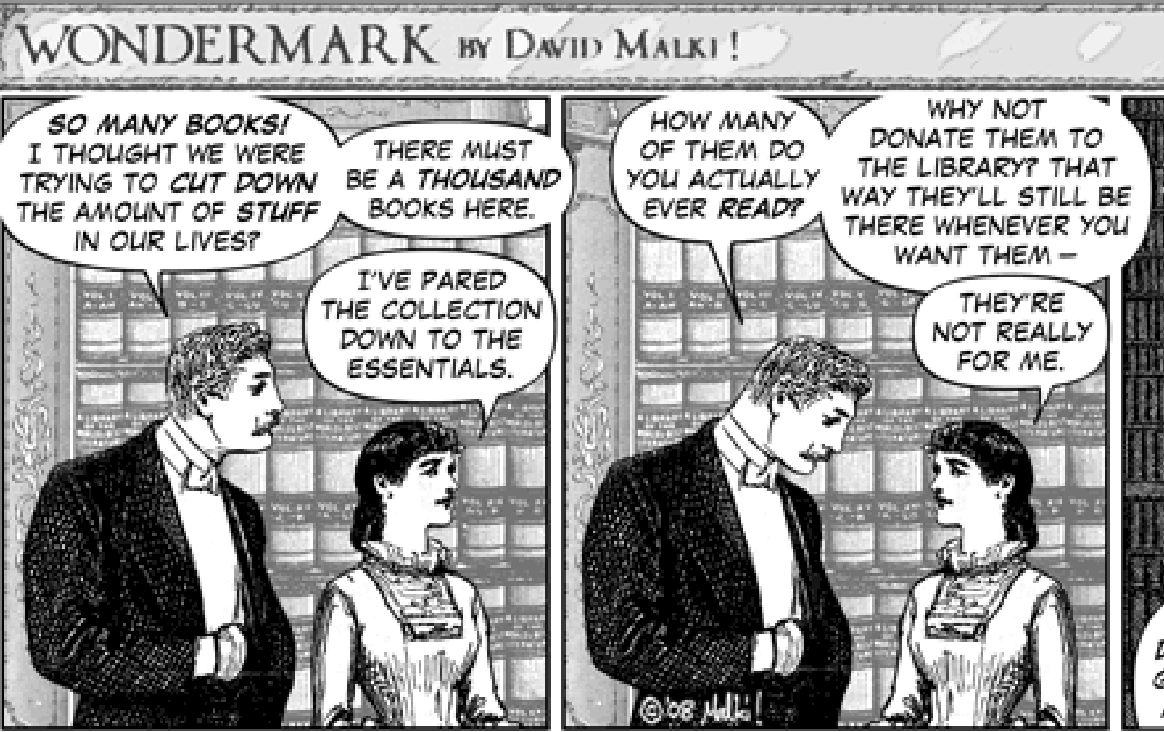
When I was a kid, I loved magazines, started at 13 with Seventeen magazine, (I actually remember this cover), graduated to Vogue and the New York Times Sunday edition at 16. I have had to continually edit my collection of torn-out reference pages to bring it back to relevant and also to prevent drowning accidents. See comic below.


I've posted this brilliant Wondermark comic before, and I will help my children mutate to live as bibliophibians but not as ... uh ... magazinophibians ... journophibians ... cartophibians...I think you get my drift.

But for the past 10 years I have increasingly felt a gap in the area of my brain that used to derive pleasure from following fashion in magazines. I still love clothes - love designers - love buying clothes (and art) from artisans who are not only theorizing but touching and making the product with their own hands. But magazines...nada. A couple are OK–Lucky and LouLou come to mind–practically no stories, affordable realizable fashion, but they still have pages and pages and pages that are not interesting to me, like all that advertising which is really what pays the bills. The entry price of the magazine is to provide tangible proof to the advertiser that future consumers of their product will actually see the ad. And now even they can hardly give them away on paper. (I mean, a $3 subscription?)


That brings us to the solution: Pinterest. I follow both these magazines on Pinterest.


I sell Pinterest to all my friends as a magazine you curate yourself. Curation is the buzzword of culture these days, and here it is again. I find streams and content that sync well with my tastes and interests. It flows past easily, and in 2 seconds I can fish out content and place it an organizational structure that has meaning for me. (Funnily, tagging is not part of it. Pinterest is for visual people, not book people. Words are not important. Images must be repinned to appear in two places, advantage is not taken of the infinite ability of one image to appear via its tags in 20 categories – actually the board IS the tag.)

Pinterest has revitalized the fun of getting dressed in the morning, of shopping for white jeans, of checking thru my mother's jewellery box for vintage brooches. It makes it feel cool to support and celebrate a local designer with little media presence...without the time-wasting of pages full of ads, full of current-paradigm issues, full of commentary, full of images for the otherwise inclined.

Plus, it gave me the nerve to buy spray paint for some storage tins, and make a small macro photography studio, and find the right glues to properly repair things around the house, and make little presents with my kids by hand...

In addition (she lectures on and on) Pinterest is safe - populated mainly by non-predators (shall we say); the social contact is actually minimal as there is little or no chat space; the social and political content is negligable. I don't worry about my kids collecting pictures of hedgehogs, or dollhouses. They may run into the f-word or tatts or men's chests, but that's about the limit. We can talk about it. They won't be shocked.

Finally, there are some fun infographics about what good business it is to appear on Pinterest - more click-thrus to purchases than on any platform, more time spent per user, more actions per user etc and this compared to Tumblr (OK) Facebook (bleh!) and Twitter (bleh!), for example. It's the new asses-in-seats, and I recommend you get it while it's hot.

The marigold wonders nervously if she should include links to said infographics? They change all the time, and the summary is stated...

Sunday, September 8, 2013

The Flying Creatures of Fra Angelico


By Antonio Tabucchi
translated by Tim Parks
Archipelago Books
2012


I have had a review copy of this book in PDF form for ages. It should have been a hot-button draw, but I just never seemed to feel like opening it on my desktop, despite its brevity. Finally, to clear up my obligation, I opened it, and found it delightful.

It seems that the writer, with  great sensitivity, wished to explore the imaginative space around certain historical objects, or episodes; he wanted to fantasize about the creation of art and history in a way that would feel like a real imaginative moment in the period. I found the little stories exquisite and evocative and delightful. Bravo. It is an exercise I enjoy, too, imagining the meetings in which movies are scripted, ads are planned, books are edited; imagining acts of imagination on their way to becoming realities.

I always try to capture my thoughts and impressions before researching or looking at other reviews. It was gratifying to realize that despite this book's appearance of being a self-published and self-indulgent effort, Tabucchi was actually a very respected academic and writer of literary fiction, and was nearly a contender for the Nobel Prize for Literature. This book was written about 25 years ago, and only pulled into English now.

Is it a coincidence that Tabucchi found his heart in Portugal, and that his post-modernism in these stories, many of which are set in Portuguese history, reminds me of Saramago? What is in the air/soil/food/water/wine of Portugal that fosters this art? My home language and culture is SO English, but I actually believe that literary art is happening elsewhere.

As someone always looking for a new thrill, I am pleased to have a new author to chase down and read through.

Now the marigold is wondering nervously about finding Tabucchi in a bookstore, about having this fixation with old guys writing about Portugal, about whether I should think up a thesis and aim for some sort of degree...

PS I have not yet found the shred of Fra Angelico that appears on the cover of the book, but I am looking. When I find it, I'll update this post.

Thursday, August 22, 2013

Batch Early Review E-books from LibraryThing, together with some thoughts about the future of publishing, and how cultural icons are rehabilitated, etc.

You may remember me writing about e-books way back in the summer of 2011, (here) that it was like over-indulging in junk food. I found that it was too true, and I was already past the point of satiation. Without the trap of time, spent with only a phone to read from (first travelling and then waiting around in a hospital waiting room), my appetite went down for reading indie e-books. However, I requested some ARCs of e-books from LibraryThing before I really realized it, and here are the reviews:

Things Falling Apart
by JW Schnarr

This one is OK - deft enough, but didn't make me desperate to get back to the stories. Dark, Canadian, random, fragmentary...not bad, but not that special.


Craving
by Kristina Meister

The premise is cool, the voice seemed believable, but I couldn't quite stay with it long enough to find out where it was going. I may be able to get back to this and fill out my impressions.


Twice Shy
by Patrick Freivald

The cover resembles my fashion look-book on Pinterest, funnily enough. Cute idea of zombies masked to pass as humans. Readable enough, but not something I find myself choosing when I have a choice of books.


I have stopped requesting new indie e-books to review. However...


ON the other hand, there is something which has driven me back to the world of public-domain classics that are available thru the miracle of the internet.


By this I mainly mean the BBC show SHERLOCK–I sort of feel like I'm part of the fandom, can't get enough, regularly rewatch episodes, getting excited by the approach of the 3rd season in November, and got REALLY excited by the announcement of a 4th season to come– but also including the two Guy Ritchie movies of the more historic Sherlock Holmes, breathe...


I happened upon a short group of Sherlock Holmes stories on my iPad. When I first went "i-" I naturally checked out all the reading resources. I have, and use, and regularly buy for, mainly Kindle, but I also have iBooks, Stanza, and Audiobooks which I hardly use, except to try their free classics, plus an app called Classics, plus a free+ app called Sherlock Holmes. For free it has only a small selection of 12 short stories, but how thrilling to go to the original text when teasing apart episodes of SHERLOCK, to find actual quotations that appear in one or the other, and I even found one of the title episodes.

It also got me wondering. Was Sir Arthur Conan Doyle a kind of genius or a popular phenomenon, a gifted hack or...what is the critical opinion, exactly? I recently heard of the rehabilitation of the composer Rachmaninoff and I am there with that. My childhood ears were filled with Tchaikovsky and Rachmaninoff and Puccini and, there but less so, Beethoven and my own first discovery, Dvorak. All super-easy superstars, sort of somewhat denigrated for their very ease of their popularity. I have always LOVED all of them, but as my music theory improved, I wondered if I loved them only for their childhood familiarity, if the music was simplistic. Needless to say, I was very pleased to hear, from Tom Allen on CBC 2 no less (see the link for his twitter feed on the sidebar) that Rach is being reconsidered as a composer, and shifted up somewhat from his lightweight class.

So, back to Conan Doyle, I am thinking of Adam Gopnik writing about Moby Dick in the The New Yorker in 2007, here, with the idea that works that would nowadays be "..., by conventional contemporary standards of good editing and critical judgment, improved..." are, in fact, hailed as genius because of their ideosyncratic irregularity.

Certainly merits some additional thought.

The marigold is wondering somewhat nervously about how one's reputation fares when one admits to liking the popular. What strength of character and reputation is required to be part of the movement towards critical acceptance rather than popular?