Search This Blog

Showing posts with label music. Show all posts

Thursday, March 4, 2021

Time to start writing again: books and food

Some of my fans have requested that I return to sharing my thoughts in a blog format. Most of these fans have the first initial M, and their birthday is today, funnily enough.

I realized that this is the perfect time to write about one of my regular thought areas: books + food.

I have a rule that any cookbook from which you get just one recipe that you use regularly has been a good investment. You can imagine that I therefore have quite a large collection. On the other hand, many cookbooks are simply wonderful coffee table books or dream fodder. Both are also categories that I adore. You can imagine that I therefore have quite a large collection of these as well. I also have a bit of depth in the historical food/cooking/recipe zone, from which I do not cook at all, but in a way that is similar to being an English-speaker and loving to feel proto-Indo-European behind English, I enjoy feeling the history behind the simple foods I actually prepare and enjoy best.

Here are a few books that already combine literature and historical food, just to get started:


On the other hand, I have pulled some ideas for eating from books that are definitely not about food. Let's begin with sandwiches, for today.

I have to say that my all-time favourite food from a book is sandwiches à la The Girl with the Dragon Tattoo. I really loved the series and I have written before (way back in 2009!) that I feel Steig Larsson busted open the Nordic procedural thriller genre with this series, and I believe it is currently one of the dominant genres out there in all culture. I might even say that its omnipresence has pushed it out beyond my ability to enjoy it. In any case, let's talk about the sandwiches. Maybe I'll talk about genre theory in another post, if you want.


Firstly, you should know that I LOVE SANDWICHES. They may be my favourite thing to eat. I have a Pinterest board dedicated to sandwich recipes. Perhaps it would be better to say sandwich ideas rather than than sandwich recipes. The recipe is simply bread + other. 

Mikael Blomkvist eats sandwiches thru-out the Dragon Tattoo series, but always using and combining just these ingredients: liverwurst, cheese and pickles. Total possible number of combos is a factorial of 3, therefore there are 6 possibilities. I use them all.  Well, I might not have tried plain pickles, but now I'm going to. And I ALWAYS remember HIM eating them, with black coffee on the side (a Swedish thing, but not at all my thing), at any hour of the day or night, deluxe or corner store ingredients, no matter.

I have (unoriginally) become a regular bread-baker here in COVID times. I usually use commercial liverwurst with sweet pickles–that has been my most favouritest combo–but I tried my hand at chopped liver using this recipe from Bon Appetit magazine. And I made chopped liver and pickles on homemade bread a few times out of it. Yes! 


photo by Alex Lau from Bon Apetit magazine


Thank-you. Next!


Recently, I made bread especially so that I can try a recipe from another book I love: The Tale of Peter Rabbit by Beatrix Potter. My little sister had this classic boxed set, and I ended up with them for my kids. I loved the stories and so did they. One of my kids will probably one day have a hedgehog pet, maybe because of Mrs Tiggywinkle. I used to snuggle with one of my kids in a way that I was the box bed and she was Mrs Tittlemouse in it. Those were some good times!


We watched this beautiful series, The World of Peter Rabbit and Friends, over and over. There is a lovely score by Colin Towns. I have an old CD somewhere, and I found a playlist on YouTube to share with you. He has had a long career in scoring and I see he scored the current series Doc Martin, and I have signed up for a trial of Acorn so I can definitely tune in to check out the music, altho it might be an interesting show, too.


And there is also the quite lovely movie Miss Potter, about Beatrix Potter herself, starring Renee Zellwegger. Perhaps not the greatest movie of all time, but inhabiting the same quiet dreamy space as the stories, and with gorgeous music by Colin Westlake. The movie is currently on Prime in Canada but I also found it on YouTube, and you can get the soundtrack on Apple Music or YouTube as well.


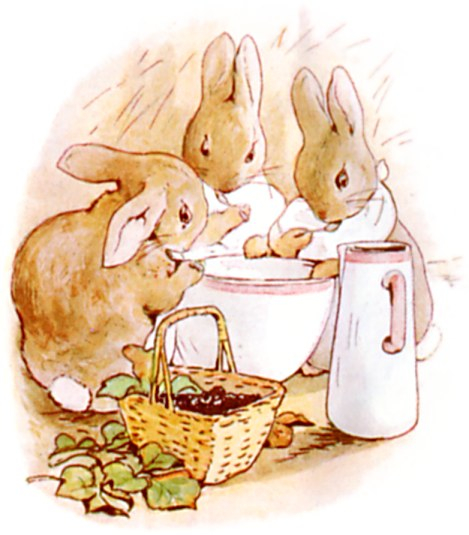
Yes, I hear you saying, but where are the sandwiches? Do you remember when Peter gets home wet and torn and exhausted and his mother sends him to bed with no supper? His sisters have a dinner that I have always (and by that I mean for about 80 years or so) longed to try.

Here is the passage and the illustration: I AM sorry to say that Peter was not very well during the evening. His mother put him to bed, and made some camomile tea; and she gave a dose of it to Peter! "One table-spoonful to be taken at bed-time." BUT Flopsy, Mopsy, and Cotton-tail had bread and milk and blackberries for supper.


We have been getting very good blackberries lately and it came to my mind to give this old idea a try. Here is my bowl:


OK, it is a sandwich only by the loosest definition, bread + other. Or I could say it is a deconstructed sandwich. Or I could just say it was so delicious I will be having it again this morning for breakfast.


I must tell also tell you about one of my favourite Instagram accounts: Eating Their Words. Virginia is actually from Toronto and lives very near to my husband's hometown of Pesaro in Italy, of all things! She makes and serves all kinds of foods out of the books she reads, and posts beautiful pictures of the food and the cover together with the relevant quotation from the book. Check it out @eatingthierwords.


I guess that might be about it for sandwiches. The marigold is wondering nervously if it is still too early for lunch...


Thursday, August 22, 2013

Batch Early Review E-books from LibraryThing, together with some thoughts about the future of publishing, and how cultural icons are rehabilitated, etc.

You may remember me writing about e-books way back in the summer of 2011, (here) that it was like over-indulging in junk food. I found that it was too true, and I was already past the point of satiation. Without the trap of time, spent with only a phone to read from (first travelling and then waiting around in a hospital waiting room), my appetite went down for reading indie e-books. However, I requested some ARCs of e-books from LibraryThing before I really realized it, and here are the reviews:

Things Falling Apart
by JW Schnarr

This one is OK - deft enough, but didn't make me desperate to get back to the stories. Dark, Canadian, random, fragmentary...not bad, but not that special.


Craving
by Kristina Meister

The premise is cool, the voice seemed believable, but I couldn't quite stay with it long enough to find out where it was going. I may be able to get back to this and fill out my impressions.


Twice Shy
by Patrick Freivald

The cover resembles my fashion look-book on Pinterest, funnily enough. Cute idea of zombies masked to pass as humans. Readable enough, but not something I find myself choosing when I have a choice of books.


I have stopped requesting new indie e-books to review. However...


ON the other hand, there is something which has driven me back to the world of public-domain classics that are available thru the miracle of the internet.


By this I mainly mean the BBC show SHERLOCK–I sort of feel like I'm part of the fandom, can't get enough, regularly rewatch episodes, getting excited by the approach of the 3rd season in November, and got REALLY excited by the announcement of a 4th season to come– but also including the two Guy Ritchie movies of the more historic Sherlock Holmes, breathe...


I happened upon a short group of Sherlock Holmes stories on my iPad. When I first went "i-" I naturally checked out all the reading resources. I have, and use, and regularly buy for, mainly Kindle, but I also have iBooks, Stanza, and Audiobooks which I hardly use, except to try their free classics, plus an app called Classics, plus a free+ app called Sherlock Holmes. For free it has only a small selection of 12 short stories, but how thrilling to go to the original text when teasing apart episodes of SHERLOCK, to find actual quotations that appear in one or the other, and I even found one of the title episodes.

It also got me wondering. Was Sir Arthur Conan Doyle a kind of genius or a popular phenomenon, a gifted hack or...what is the critical opinion, exactly? I recently heard of the rehabilitation of the composer Rachmaninoff and I am there with that. My childhood ears were filled with Tchaikovsky and Rachmaninoff and Puccini and, there but less so, Beethoven and my own first discovery, Dvorak. All super-easy superstars, sort of somewhat denigrated for their very ease of their popularity. I have always LOVED all of them, but as my music theory improved, I wondered if I loved them only for their childhood familiarity, if the music was simplistic. Needless to say, I was very pleased to hear, from Tom Allen on CBC 2 no less (see the link for his twitter feed on the sidebar) that Rach is being reconsidered as a composer, and shifted up somewhat from his lightweight class.

So, back to Conan Doyle, I am thinking of Adam Gopnik writing about Moby Dick in the The New Yorker in 2007, here, with the idea that works that would nowadays be "..., by conventional contemporary standards of good editing and critical judgment, improved..." are, in fact, hailed as genius because of their ideosyncratic irregularity.

Certainly merits some additional thought.

The marigold is wondering somewhat nervously about how one's reputation fares when one admits to liking the popular. What strength of character and reputation is required to be part of the movement towards critical acceptance rather than popular?

Someone besides Nigel Tufnell says D minor is the saddest key, and he proves it!

I couldn't believe it when I heard Tom Allen say that someone had been mashing up works in D minor to home in on a quality or "colour" that defines a key signature. I went to the CBC Radio 2 website, and there it was:

Paolo Pietropaolo's The Signature Series.


Not all the keys are there yet, but my favourite is...
D minor. He does say it is the saddest key! He also credits Spinal Tap. I am verklempt!


Although at this point I could say that no more need be said, but I will undoubtedly say more at some point.


PS Right now there are about a dozen keys defined in this way, and it's all fun.

Saturday, April 14, 2012

I will never give up on the sadness of D minor

Or: Why do composers choose certain keys?
Or: Is D minor the saddest key?

I occasionally review the stats on this blog, and to my endless surprise (and pleasure, I must admit) it is my original post on D minor that gets the most attention. I, myself, am still fascinated by D minor as a key, and by the idea of key selection. I am endlessly quizzing my music teachers (I have two, now) about what the real meaning is of keys having a "colour" and how if the technology now permits playing in an easy key while hearing the music transposed to any other key, who is really choosing a key for the "colour" of the "sound" now?

In the two years since I wrote my last post about D minor, (and four years since I wrote the first) I have studied a lot of music theory. I still have the same questions, but I can now understand some of the answers. As I've said before, and if I've said it once, I've said it a thousand times, the key to adult education is repetition. (Get it?)

Here is the classic scene about D minor from This Is Spinal Tap (1984), just to get started:


A number of people have cited this bit as the actual source of the idea that D minor is, in fact, the saddest key. I think Nigel Tufnel (played by the brilliant Christopher Guest, aka Baron Haden-Guest. Yes.) is able to claim this because there is an older link from D minor to the dorian mode, which is the order of tones and semitones you have if you play the octave of white keys only from D to D, and historically associated with the qualities of 'serious and tearful', and considered to be the saddest mode. The names for modes come from ancient Greek music theory, but the names were re-purposed in the medieval period and then again (roughly) 300 years ago, to talk about scales. The actual name for the sequence of tones and semitones we know as a (natural) minor key, such as D minor, is the aeolian mode, but the minor triad on D (D - F - A) from the aeolian mode also matches up with dorian mode (ie all white keys running from D to D).

The real doorway for me was starting to learn guitar. (Too much time on my hands, I guess). After a few weeks, my teacher asked if I wanted to learn a Neil Young song, like Harvest Moon. Now Neil Young is a god of the guitar, and comes from the golden age of acoustic guitar, the 70's, during which period I was a teenager, so naturally I said OH yes! A Neil Young song! Yes! But the song I want to learn is Old Man. I have always loved this exquisite song, and I love the new version, too, by Redlight King, in which Young's music is sampled, actually the only time Young has given his permission for sampling. (BTdubs, Young and Mark Kasprzyk, known as Kazzer, from Redlight King, are another couple of nice Canadian boys! Go Canada!)

Here are the videos:
Neil Young:


Redlight King:


This song is given as written in D major, and starts and finishes with D major (the triad D - F# - A). The chords in the song are D - G - F and a little A minor. Wait a minute - that is not the usual rock music pattern (which in D would be D - A - G) , nor is it really D major, with that F natural chord instead of F sharp. I asked my guitar teacher and he said think about D dorian. No, that's not right either - no D major in D dorian, only D minor. However, my piano/theory teacher said think about a D blues scale, and BINGO! Access to both D major and D minor, and A minor (A - C  - E - all white keys not the A - C# - E of D major). A blues scale mixes major and minor chords, and on D mixes major and minor, aeolian and dorian (and the major scale mode, ionian, but who's counting).

There you have it - the D minor triad connects with dorian, and aeolian and also connects with blues in D, with its major/minor options. Blues = sad music, and the blues in D has the historical dorian element as well.


Now, I also have something fresh to say about D minor. I recently read a new book called Chopsticks. There is nothing I like better than a project with multiple strands. I know nothing about the author, Jessica Anthony, but the book's designer, Rodrigo Corral, has already made it onto my "cool-hunting" book designer list (Actually I saw a joke cover he did in a short piece in Wired magazine a few days before I received this book, and the name struck me. Shout-out to Scott Westerfeld - I think of myself as a trend-setter, the way he explains it, not one of the very coolest, known as innovators - I like to catch the trends quickly, often thru magazines. I don't make them but I get on them early. Loved his book So Yesterday. For that matter, covering something like the same ground, I loved William Gibson's Pattern Recognition to the extent that it is one of my all-time favourites. But je digress. Sorry, can't seem to stop today.)

So...every now and then a book appears that merits a second, or even a third look, and Chopsticks is one. At first it seemed like the most interesting thing about it was its existence as a new type of book: a story told thru a modern selection of ephemera and epistles - texts and playlists, for example. Interesting, but, for me, of uncertain value, both narratively and aesthetically. Then I thought about tracking down the YouTube references embedded in the "texts".

As I was paging thru the book, I started to rethink my impressions. OK - on one level it's "Romeo and Juliet with texting" (with a little West Side Story ethnic mix thrown in for good measure). Cute. Then, well, the girl is actually a piano prodigy, and her various performance pieces are shown on bits of ephemera, before the texting gets underway, and I started to look them up and listen to them (mainly the adagio movements, I confess. Love the sad music.). Then I realized they progressed with her distress from two pieces in Eb major via a couple of shorter pieces in A minor and B minor to a piece in C minor to BRAHMS FIRST PIANO CONCERTO IN D MINOR! OMG! ONE OF THE MOST BEAUTIFUL AND SAD PIECES OF MUSIC EVER! QED: D minor is the saddest key!!!!  (I should just write QEDminor.) And isn't that a circular progression? And doesn't it mirror the arc of the narrative? Nice!

Here is the great Arthur Rubenstein performing the first part of the second movement, the adagio, natch, of Brahms Piano Concerto No 1, in D minor, Op 15:


and the second part:


It's a lot of listening, and a little old, but worth it.

Then I started copying the playlists, thinking about whether they were related thematically to the plot, or more like  leit-motifs for characters, (already a nice, and musical, level of sophistication in a book). It will take some time, but I will listen my way thru them, too, even the pieces I know, in order to work out their places. Then I ran into some of the YouTube references. Funnily, the first one in the book didn't seem to work for me. I thought "Oh! It's bogus." I decided to try one more before giving up, and it led to a delightful and meaningful link. I went back to the first, and typed it in slightly differently, and watched in surprise until it made sense, too. I checked them all, and even tracked down the things that were at one remove. Fun? Wow!

And I found one that doesn't seem to have attracted the attention of the young lovers, by a pianist who is actually quite a fascinating prodigy himself.

Surprise!


And then I finally went to look up some stuff about Anthony and Corral. Nothing much is available. I guess I have to send in my own questions. (I have sent my questions to their publisher, but have not received any reply. Oh well, I guess they are not the nice Canadian type.)

Back at the time of my first post on D minor, Dory left a comment recommending a resource for  understanding key characteristics, called, strangely,  Characteristics of Musical Keys, kept by Mickey Koth, a fiddler and music librarian. The site is really a meta-site with links to all kinds of key-identity resources. It's a lot of fun and quite interesting, if you are motivated to look further into it.

The marigold is wondering nervously if everyone is familiar with QED? Just in case, it is Latin, Quod erat demonstradum - Thus it is demonstrated. Is that not a useful Latinism? Can you use it in a sentence?

Wednesday, January 18, 2012

Special Music Issue - Just to Share


I was hearing this song, and loving it, (thanks to Afrouz) and I finally took the time to find it on YouTube. The fun thing is that they are a DJ and singer from Montreal/Toronto, and the sad thing is that they are no longer together. The song is awesome. There are these two great videos that go with it: the first one won a contest to be the official video for the song, but the other is also cute and good for sharing with a general audience. There appear to be more videos of this song, plus remixes and all kinds of other cool Thunderheist songs, but you can just go search them on YouTube on your own!


The marigold wonders if it would be useful as a status message on Facebook or BBM or whatever: I am dusting it off and jerking it. Maybe not. I think it would make me nervous.

Saturday, October 8, 2011

Opera and Kids, Version 20.11

First this breaking story: Yes! A breaking opera story! Who knew? And you read it here first!

Jacoba Barber-Rozema, a very young Toronto opera singer, whom I interviewed for this post, and hoped to be able to follow in her future performances, has just won the role of The Shepherd Boy, in Tosca, to be performed by the Canadian Opera Company early in 2012! This is so exciting! Can't wait to see her. Or should I say hear her! Keep reading this post to find my interview with her after her first outing on the COC stage this past spring.

And now back to our regular programming:

My plan has finally paid off! Choosing artful, beautiful opera performances to share with my kids, in order to let them be open to opera as a source of pleasure in life, has worked!


One of my kids has most willingly gone to the opera the last few times, but this summer my kid generated the idea of selecting something to see at the Rossini Opera Festival, which takes place in the town where we vacation. But a funny thing happened on the way to the forum, literally. We chose Mosè in Egitto, for the story, showing at the decommissioned sports arena. The day after we bought tickets, it was revealed in the local paper that the young(ish) socialist, English, stage director, Graham Vick, had decided to use the opera as a metaphor for the displaced people and freedom fighters of our day, complete with land mines, and machine guns and burqas. Many people found the idea distasteful, we thought it might be frightening, and we heard later that it was not well-enjoyed by the audience, usually composed of long-time festival fans. Luckily we were allowed to change our tickets for something else. We had heard that the scenography of Adelaide di Borgogna, featured video, while the costumes and props were in period, so we thought it would be the right choice to engage a kid, and it was.


Adelaide, an opera based on a true story about a strong and influential woman of 1000 years ago (the wife of Otto I, the first Holy Roman Emperor), seen from an old-fashioned box, in a theatre built during his lifetime in Rossini's home town, was a smash hit, at least in our family! I always love the ROF for making it possible to see the lesser-known, if not unknown, Rossini works. The singers are often specialized in this beautiful bel canto repertoire and I have to say most of the performances were really thrilling. Especially fabulous was Daniela Barcellona as Ottone (Italian for Otto). She is beloved for pants roles in Rossini operas at the festival, and for good reason. And in this case, I have to leave the music comments at that, because it was director Pier'Alli's multiple video screen backdrop that made the whole thing notable. It was pretty fun, if not exactly perfect.


photo: Elio Crociani


There were endless raindrops falling in puddles, artful pathetic fallacy, but also giving a sense of the time of year and the life of a soldier in a camp in the plain of the Po River at the time (ie the year 950!)


photo: Elio Crociani


For much of the opera, the look was sort of Battleship Potemkin, maybe kind of an homage to Eisenstein?

photo: Elio Crociani


Strangely, at the end, we got into floating umbrellas alla Magritte and a royal coach, all early 20th century - rather awfully out of period - but as James Ehnes said when I (sort of) interviewed him for another post on this blog, art comes from commitment, and I certainly would rather see a failed reach for the stars than an easy sure thing, so I was good with the attempt.

The enthusiasm of my bigger kid left my littler kid saying "Isn't there an opera I can see?" and we had to say "Sorry, that was the last night of the festival! Next time."

I think this success was built on our other opera outing of the year,  the Canadian Opera Company's Ensemble Family Performance of Mozart's The Magic Flute this past spring. That was a wonderful evening. The tickets were at the right price to allow for a rustling and restless audience filled with children, and even to leave early if need be.

Of course, The Magic Flute is not only sensational musically, with quite a few parts familiar to many kids, but also has a brilliant story and the surtitles had everyone laughing at jokes we could not have understood otherwise.

photo courtesy of the Canadian Opera Company


As well, and here is the connection, it also benefited from great scenography and innovative rethinking of the staging, and fabulous costumes. I mean, punk-viking girls with glasses! Does it get any cooler? And the idea of a play being performed at a garden party within the opera, the small stage slowly taking over the larger, was really well executed.

The whole effort absolutely showed the comedic sense of pre-romantic opera, rather than the tragic of the romantic and post-romantic tradition. (I want to say baroque rather than pre-romantic, but I don't want to get into another argument about it. I am still working on a post on my own theory as to what should constitute the end of the baroque period, and why the "classical" period is really just transition from baroque to romantic, and doesn't deserve to be considered a separate period, and that Mozart actually bridged over the end of the baroque into the "classical", crossing paths with Beethoven who took up "classical" and pushed it into romantic and...wait...take a deep breath...I'm supposed to be saving this idea and my research for another post.)

photo of Nicola Smith, First Spirit; Emily Brown Gibson, Second Spirit; and
Jacoba Barber-Rozema, Third Spirit;  photo courtesy of Jacoba Barber-Rozema
In any case, the killer feature of The Magic Flute for us was that a girl from my kids' school had a big role, as the Third Spirit. Her performance was SENSATIONAL and we will be hoping to follow her career as the first members of her fan club. She managed to dig up for me a picture of the spirits crossing the stage, pedaling slowly, but traveling very VERY slowly on their enormous tricycles, while singing ethereally. The effect was amazing, and audience members of all ages loved it. The spirits are really major, spending quite a bit of time onstage through-out the opera, so it really went a long way towards the overall success of the performance that they were so effective and so effectively staged. The kids I was with found it incredible that a schoolmate was such a star.

And...it's not every day that you can ask a very young opera singer what they are all about, so I found a mutual friend who helped me ask her some questions, and I got back some very interesting answers.

Nervous Marigold: Do you want to be an opera singer, or is this a way of rounding out your experience, or testing opera as a future career? Or other?

Jacoba Barber-Rozema: I saw my first and "fell in love" (I guess you could say) with opera when I was 8, and knew I wanted to be an opera singer since I was 10. Being in Flute and seeing more and more of what the professional life is like, makes me want to do it even more. But it's definitely not the easiest career! You said you saw the Ensemble show? Unfortunately, I didn't spend very much time with that cast, which I would have loved to do. It gave me a more realistic look at first cracking into the business and it was a completely different energy - much more excited. I'm fifteen now and my dream still hasn't changed, but who knows what the future holds.

NM: Was it weird doing a pants role? Do you sing in your adult voice, or is that still to change? Are you a soprano now, and what will you be in the future if it is different?

J B-R: You know, doing a pants role was actually a lot of fun! At the very beginning, at the audition, there was kind of a competition to see who can look the most like a boy, but I'm very good friends with the other girls who were chosen, so that soon faded. The lovely Isabel Bayrakdarian, who sang Pamina, once called us "bearded ladies", which we found very funny. I am a mezzo, but I sang the third spirit in flute. I think my voice is still yet to change, yes, but probably not too drastically from what it is now.

NM: What is your favourite opera (and maybe why)?

J B-R: My favourite opera is Madama Butterfly. I got to see it at the Met a few years ago and it moved me to tears. I love the contrast of Puccini's light music in an opera with such dark themes. [It was my first opera, too. - ed.]

NM: What is your favourite current song? (Do you have Bieber fever, like Emily [our mutual friend - ed.])? OK - this is a bit banal, but it's so fun to know.

J B-R: That's too hard! I think I may have Beatles fever, if there is such a thing. I know every song, so that and other sixties music is mainly what I listen to. As for contemporary music, some of my current favourites are Regina Spektor and Ingrid Michaelson. It's been SO strange not rehearsing or hearing music from The Magic Flute, so I've been listening to a lot of that lately. I ate, slept and breathed Flute for almost a year and suddenly it's completely gone. Sometimes I have dreams about it - the pre-show adrenaline, listening to the overture while watching from backstage and waiting for the curtain to come up. I hope my future opera experiences are even half as amazing as The Magic Flute was.


What a clever and interesting person, in addition to being a gifted performer! How rare! How inspiring! What a great role model for arty kids!

La Clemenza di Tito, photo: Opera Atelier
Finally, and related, although not thru the kid connection, this spring I saw my beloved Opera Atelier with no kids, (thank-you, Diana!) as usual doing their utmost to specialize in the obscure, performing La Clemenza di Tito, an opera seria by Mozart. I noticed that I had seen the cast before in Idomeneo in 2008, that is, fabulous soprano Measha Brueggergosman and exotic male soprano Michael Maniaci and the amazing tenor Krešimir Špicer and others. And in fact, at the performance I learned that, very delightfully, OA had promised this cast to bring them back for Tito.

Idomeneo is considered Mozart's most successful opera seria (a HIGH BAROQUE form - notice this, James Ehnes - most often used to praise or flatter a monarch or noble). I really loved it when I saw it, and here is my review from that performance.

Tito had everything in place - but somehow was less of a thrill, just as historical critical opinion would have it. Luckily we were told in artistic director Marshall Pynkoski's usual on-stage opening remarks about the personal commitment of the performers to doing the opera. I think it gave everyone a warm fuzzy open-ness to the production. He explained that that the story was well known to audience's of Mozart's period. The program illustrated the point on the cover, using this quotation from Racine's play Berenice, instead of a picture: Pity my rank. Lord of the world, I guide its destiny. I can make kings and unsceptre them, yet I cannot give my heart to whom I choose. WOW! The opera tells the true story of the Roman emperor Titus. He was renowned for both his love for his Judaean mistress Berenice, whom he sent away, realizing he could never allow himself to marry her, and his clemency toward a couple of traitors, refusing to have them executed, and in fact sharing an inspection with them at the arena. It is marvelous to think of things that were once so well-known and admired, that are now so completely gone from culture.  I know, I know, like "opera", right?

On the other hand, although the music was lovely, and the performance was fine (despite a funny scene-changing error, requiring a hot two-girl kiss scene to be repeated while they finally made the change), but somehow no thrill. Won't stop me from going to Don Giovanni, which they are remounting this fall. [ed. note: just about now] The 2004 performance of Don Giovanni was my introduction to Opera Atelier, and I have had a crush on the company ever since.

Don Giovanni, photo: Opera Atelier


As to the idea of everything connecting...well...I guess within opera everything does connect somehow, but...

To start with, Tito was written by Mozart as a commission for the coronation of Holy Roman Emperor, Leopold II and Mozart wrote it at the same time as he was working on The Magic Flute.  Cool. More interestingly still, (to me) is that Adelaide in Borgogna felt like opera seria to me, about pair of monarchs of high honour and personal bravery. When I was looking for a connection, I saw that Rossini was called "the little German" because of his admiration of Mozart. He was born in 1792, a year after Mozart's death, and apparently he attempted to revive the baroque-leaning opera seria style. But for whom? During this period he worked for an Italian princess, for Charles X of France, and for Charles's father- or grandfather-in-law Ferdinand IV of Naples. Although it seems he wrote Adelaide for one of the commercial opera houses of Rome, Charles and the Ferdinands were important Bourbons with the royal family's strength based in Burgundy. I wonder if it was just on his mind, or if it was a hopeful attempt to flatter? I wonder if the truth is out there?


Now the marigold is wondering nervously if it is possible not to kill this fragile bud of kid-interest with over-enthusiastic adult encouragement. Perhaps I should start discouraging interest in the opera, to get them really going? Or is that too much of a game? Plus, why are there so many editorial comments in this piece? Who is that nosy editor, anyway?

Monday, July 18, 2011

Notes from Italy - Good and Bad - 2011


 Good - Food, of course! Burro di Bufala (butter made from buffalo milk [as in the mozzarella]) is awfully good. I think it might be a new product even here, as I have never noticed it in the stores here before. I had read about it in a magazine not long ago, and possibly it is available all over the world by now. It takes a lot to get me to pass up my beloved Burro Sorresino, which comes in an adorable old-fashioned yellow tin, but I had to try it, and it was worth it. Even the butter, on toast, has that slightly “farm-y” taste that I love in mozzarella di bufala. I am keen to try making a spaghetti alla carbonara with it. I love butter with the eggs and bacon of carbonara, even if olive oil might be more authentic.

I am always impressed with the care given to every part of food here. I live in a more northerly climate, in the middle of a big industrial city. Everything is grown elsewhere and shipped in, except for a very few precious items, which can be found in a very few precious restaurants. Food pleasure is available, and must be taken where you find it, but fresh and local, it mostly ain’t.  On the other hand, here everything is fresh and local, and that actually can be so extreme as to limit the menu. It makes me laugh (on the inside) when people are asked to describe what is served at a new restaurant in the area, because the local menu is already set. 
BUT, when you shop at your  little local grocery, the farmer picked the figs (ficchi bianchi - white figs in this case) this morning, and brought them in to his friend at the store (in a kind of gray market transaction). The shopkeeper asks if you are eating the melon right now, because she wants to sell you one that is PERFECTLY ripe right now. The different plums have different seasons a few weeks long and different names, and the nearby town of origin is indicated (or the province of Italy, if they happen to come from that far away – which is still only something like identifying peaches from Niagara in Toronto). The bread has to be eaten today, and all milk is only sold by the litre, and lasts only 3 or 4 days. That’s pretty fresh, and unpreserved.


Bad - Internet access. Will the torture never end???? Somehow trying to arrange for internet access showcases the worst of Italian organization. So much potential, so much openness to new technologies, so much bureaucratic bungling and delay. The past couple of years I have really been excited by the prospect of mobile internet access, and I even bought a device that not only receives a mobile internet signal, but broadcasts to its own little wireless network. Isn’t that awesome for a family of tech users – one little mobile key, powering the internet on a number of devices, and portable to boot? Last year we arrived in mid-July. By the time I purchased the device and tried my best to set it up, fruitlessly, it was already August, the Italian vacation period (yes – all of August) and no qualified help was available. I limped along, at least, with one wireless connection to my device. OK. This year we arrived good and early. I went in good and early to get help setting up the network. No problem. Bought a new sim card, loaded in unlimited data for 30 days. 36 beautiful hours of a mobile wireless network. Then…it died. And the bill had gone home to Canada, and there is no recourse. Now I am in the midst of trying transfer of the sim to my iPhone, in order to take advantage of the access I have paid for, but it does not seem to like it. Of course - the is phone locked! Should I try putting the sim in my old phone, in case unlocking an iPhone buggers it up for use when I return to Canada? Another visit to the stupid store, to figure it out; I almost can’t face it. Many of our favourite bars offer free wi-fi, but…access is complicated and many of the baristas don’t know how to sign you in, and…there are unexplainable periodic interruptions in service, and…we don’t usually go around with computers, for writing, but rather iPhones for jotting. However…


Good – Opportunity to read! I don’t know if it is the heat, or the freedom from the school schedule or the small town pace we are forced to adopt, or our lack of access to TV during all this spare time, but I feel such a sleepy torpor here (is that redundant?) that I spend a lot more time reading than I usually can. I find I am totally able to read whatever I want, no matter how challenging, or silly for that matter. Shout out to Gil here: I finally understand how to enjoy reading an e-book.

If you read an e-book in bed, when you are tired, and you stop touching the screen to turn pages because you are falling asleep, the BOOK SHUTS ITSELF AND TURNS OFF THE LIGHT, so you don’t have to! Oh yes! I had a some books that I was waiting to get at: a couple of LibraryThing early review titles, and I had bought an indie book from Amazon, on principle, from a girl who wanted to share her writing at the price of a tune on iTunes. You go girl! (This is a screen shot of Amanda Hocking's book on my phone.) And then the book turned out to be fun enough for summer reading, when I got around to reading it last week, that I went ahead and bought the 2nd book of the trilogy. Then I uploaded a couple of sample books from my desktop into iTunes to sync over, and I plan to grab a couple of public domain classics if I can. Now all of you nay-sayers that say “Oh, it’s too small” and “I could never get used to it”: nonsense. Self-shutting-off-reading-light-and-book in one? Doesn’t get better than that at 2:00 a.m. (Said by a person who has always envied insomniacs their extra reading time.)


Bad – No bird watchers among our acquaintances. I think that Pesaro might be quite a diverse mini-eco-system? bio-zone? –sea and shore and rivers and hills, with quite a large nature park nearby. I feel that the birds have multiplied in number and kind over the years I have been coming, probably due to deliberate action to preserve the biosphere, and possibly by the dwindling of the fashion for hunting and eating them. I have a guidebook, but I find I like to look at a few guides to compare for identification purposes, and I can hear lots of birds that I can’t identify through a book. I need a knowledgeable person to tell me which bird makes that trill I am hearing and what bird makes that croak, and whether those large black-winged gulls that I see, which seem to really be northern birds, do in fact range down here now. On fish and shells, a lot of people are pretty good. Birds – still looking for someone.
(PS This is a Blue Tit, the local chickadee, and I have actually seen and identified one this summer, as I usually do. It is just that my list here is so short, darn it!)


Good – The local art shows look promising this year. I plan to attend an opening at the civic museum on Friday, and I have an acquaintance who told me about a small kind of private museum of works restored on behalf of the city by a local business association, and the "new art" museum in town, Centro Arti Visive Pescheria, which is the old (ancient) fish-market is closing a show of documentary photos (yawn) and opening something to do with Rossini that looks fun (yay!)


Bad – None of the music on offer looks like it will offer the thrill of the new that we have enjoyed other years. The Rossini Opera Festival seems to be scaling back (I imagine it’s all about the money). The ancient music series that we have loved in other years is all out of town, so less amenable to impulse. I might try to catch a performance of Rossini’s Petite Messe Solonelle, which is beautiful, and is usually offered several times by several different performance bodies. I've already missed one, but we’ll see,

Sunday, May 15, 2011

Writing about music is like dancing about architecture

Sorry this has been  so long coming - you'll see why as you read on.

I was so pleased and surprised, and yet not so surprised either, that my two besties (as I like to think of them) James Ehnes and Tom Allen, both wrote me back courteous letters in answer to my questions! Two things are in play, I guess: I often think that they are both wonderful examples of Canadian nice-ness; and the public personalities that you FEEL might be sympatico ARE sympatico. James Ehnes, especially, who kindly wrote twice, gave me some real food for thought. I have provided a link to Ehnes's home page under Music Links and Allen's twitter feed under...uh...Twitter Feeds. You can check them out for yourself.

Also surprisingly, or not, as I was engaged in this correspondence and thinking, I realized I had arbitrarily chosen a couple of books to read lately that involve violin history, which was quite fun:


Revolution by Jennifer Donnelly, is a new book, for young adults, with a little time travel back to the French revolution as a way of approaching homework. The main character is a high school senior with issues and talent and family wealth, yet the story is surprisingly un-clichéd.


Fabrizio's Return, a remarkably adept book by Ottawa writer Mark Frutkin. His Italian is good and the setting feels very natural to me, and in accordance with my experience of a medium-sized Italian city. One of his characters is Niccoló (by implication Stradivarius), a violin-maker in Cremona, historic home of the violin.


Uncle John's Bathroom Reader Plunges into Music.
 And credit where credit is due - I could not resist this book, which I leaf through...well you know where...and it had a nice couple of pages on the mystery and history of Stradivarius, along with entries like: Bagpiper's Fungus and Twelve Recordings that Changed Music and Odd Homemade Instruments and 16 Random Lists About Frank Sinatra and...you get the picture.


Once I start thinking about similarities, I think about whether there exists a category, so I thought up some other works in the category of violin-history:


like the silly film The Red Violin,


and the remarkably beautiful book  Stabat Mater by Tiziano Scarpa, currently only available in Italian, winner of the Strega prize for literature in Italy. (The word means witch, and it is the name of a absinthe-style liqueur and the prize seems to be awarded to witchy, absinthe-style books - dark and tragic). Stabat Mater is the heart-rending story of an orphan girl under the tutelage of Vivaldi.


Of course that sounds like Vivaldi's Ring of Mystery, from the Beethoven Lives Upstairs CD Series, also about an orphan, who rather happily turns out to be the daughter of the duke of Cremona, who also plays a violin for Vivaldi. I had to make a new tag for my catalog on LibraryThing.


So anyway, I was kind of bogged down, with too much to think about and no way to pull it together into a post. As you all know by now: I think everything is connected and long to uncover and understand all the connections. Then I agonized, but AGONIZED, about how to edit a long interview to be more punchy, until my friends said to me "If it's all interesting, and it needs to be complete, just post it all. We'll get through it. Duh!" And then, I must tell you that since Jimmy E (as I like to think of him) had mentioned the old saying that writing about music is like dancing about architecture I thought, well, why don't I just finish up and post that video of myself dancing about architecture that I've been working on, as there seems to be some demand for it, but then I thought, no...I'll just finish up writing about music, so here it all is.


Really, the comments made by both Ehnes and Allen pushed me to think about what I thought - hmmmm - does that work? - and learn from them what I did not understand previously, and defend my ideas more robustly where I was too casual in my assumptions.

I decided that what you would find interesting is some of the back and forth. This first post is about playing an old instrument in the current style, which I was finding puzzling as a choice, and about playing Mozart. In a future post I'll cover some ideas on what defines the Baroque period.

Here is the note sent to me by Tom Allen:

If I understand your question, I think you're asking when violin playing progressed past what we now call baroque playing - is that right?
The question is more one of when did people start considering that the old way of doing things might have some merit.  Violin playing went through a huge surge in development around 1700, and then again in the early 1800s. Bows and bowing changed to produce a louder, harsher sound and techniques with it, but it wasn't until Mendelssohn began looking into JS Bach's music in 1829 that anyone really thought there would be any benefit in looking back.  Music was about progress, and the only music worth hearing was new music. Without recording, people simply didn't hear pieces more than one or two times and didn't think that unusual.(My emphasis, NM) Interest in older music, beginning with Bach, slowly increased through the 1800s, but even as late as 1949 it wouldn't have occurred to people to investigate how Bach's music would have sounded in Bach's time.  That only started in the early sixties, gaining major popularity through the 70's.

Allen has made a couple great points. I knew that playing period style on period instruments was a relatively modern idea, but I was overlooking the fact that in all the arts there is a strong drive toward the "NEW" which keeps things going forward, especially among the premiere practitioners or virtuosi. I should have been able to think of that.  Also - the very idea of recording the performance for multiple listenings! That is a terrific example of technology actually driving art, one of my special sub-interests in the category of all artistic achievement, and I completely overlooked the impact of recording on playing style and choices.

Ehnes gave his own reason for his playing style:  


When I perform a piece of music, my goal is to be completely, 100% convinced of my interpretation. Only then do I feel there is any chance of convincing my listeners. Naturally, I am influenced by the playing I hear around me, and my experiences as a listener inform my sense of taste and style. The playing I enjoy as a listener is playing that I consider to be musically committed.


So I wrote back to him:
I was thinking about what you said, and although I did not get it immediately, overnight I had a kind of epiphany: the sound and expression you consider meaningful you create when you address music of any period, with your current technique, played on a piece of technology in which an old box, with some re-engineering and modern parts (like strings), makes a beautiful sound, loud enough to fill a large modern concert hall, work with a modern-size orchestra, and reach an audience which responds emotionally or even passionately to the performance. I get it, now, I think.

I am always interested in how technology both drives and constrains art, and I just couldn't fit the pieces together quite right for the violin. The technology can be used in any way to support the art in any way. Not everyone will agree with or find pleasure in every choice, but who cares? I too believe commitment makes art. (Can't seem to get this the right size - sorry. NM)


I scored this response:
I think you get exactly what I mean!

Phew! I could do a dance-video about this, too, perhaps. Maybe I'll get to work on that, later. 


I can't say what a thrill it is to get information like this directly from the artist. It makes sitting in an audience of thousands feel so personal. 


I will even feel that we are having a personal exchange on the subject when I watch my friend's copy of the Ehnes DVD Homage with her, on which he plays: "...on 12 of the greatest instruments ever made. The Fulton Collection is perhaps the most important private collection in the world and contains many examples of the legendary names Stradivari, Guarneri, da Salo and Guadagnini. 

Ehnes performs 21 selections in a carefully planned recital programme specially chosen to suit each instrument and to work on its own terms. It finishes with a section comparing each instrument in an excerpt of the same piece, a unique opportunity to contrast the sound qualities of these spectacular instruments."


Yeah, baby!


Then, to begin the second part of our "interview", here is picture of the opening of the score of Mozart's Violin Concerto No. 5 In A Major K.219 in Mozart's own hand, just for the beauty and awe of it.


I love to see the "hand of the artist", so much less common for the composer than the performer. But in order to also see a special part of the hand of the performer-artist at work, I asked Ehnes about his approach to the pieces I saw him play, Mozart's Violin Concerto No. 4 in D Major, K.218 and Mozart's Violin Concerto No. 5 in A major, K.219 "Turkish".


When we were listening to your cadenzas, they sounded very similar to each other and with enough fast fingering (like Paganini, which I have also seen you play) and discord to sound very modern. I understand that it is the tradition that the soloist improvises or composes the cadenza. On the other hand, the program notes for the concert indicated that Mozart was one of the first composers to score the cadenzas in his concerti. As you have gathered, I am no expert on music or the violin, (although I am an ardent learner) so I am of course wondering whether you or Mozart or some combination is responsible for those musical moments which were the most interesting of the performance.

And got this very personal answer:


Cadenzas – while Mozart did notate some cadenzas for some (though not all) of his piano concertos, there are no surviving cadenzas for his violin concertos, and it is doubtful that he ever wrote any down. The cadenzas you heard were all mine; when coming up with them I took into account the form and length of the surviving cadenzas for his piano concertos of the similar, early period (there are a few from the 8th piano concerto, I think? Maybe 9th – can’t remember), and tried to take into account the types of figuration he wrote in his piano works as well as the kind of virtuoso violin playing that would have been popular around that time. Not Paganini, it is a bit early for that, but some of his predecessors, like Viotti, Locatelli, etc. Even late-Vivaldi. I’m glad you found them interesting! 


Says me, "Some listening homework to do, here."


As a further exercise in comparing modern and period playing of a Baroque composition, I dug out my Nigel Kennedy version of Vivaldi's Four Seasons and added it to my iPod. Kennedy is a punky-looking and -playing genius who specifically wrote in the notes for his all-time best-selling Four Seasons CD (1989) that he did not want to be beholden to tradition or period in his performance.
 
I already had Il Giardino Armonico's Four Seasons CD (1994) in there. They were about the first period chamber orchestra in Italy. I think I can safely say that the period performance movement started in Great Britain, and remains strongest there, and Il Giardino was radical for Italy at the time. I first heard this performance on my beloved CBC Radio 2 (or CBC FM as it was those many years ago.) I have loved this recording and memorized it with so many listenings, relegating Nige to the shelf. It's great to have him out again, and I have been playing them side-by-side as I walk, and drive, and listening carefully. They are actually both just awesome, and I keep coming up with new questions. 

Sadly, IT APPEARS THAT THERE ARE NO EHNES RECORDINGS OF VIVALDI AVAILABLE! I checked for music on iTunes, CDs and even had a look at the DVD. Oh man! How is this possible? I would really have loved to put an Ehnes version beside the other two icons, too.

Right now the marigold is wondering, not-so-nervously, about why Vivaldi chose the keys he did for each season. It is a delightful little chromatic grouping, and each of the three sections of the seasons is written in the same key:
Spring - E major
Summer - G minor
Fall - F major
Winter - F minor
Why? Answers or suspicions welcomed.