Search This Blog

Showing posts with label kids. Show all posts

Thursday, March 4, 2021

Time to start writing again: books and food

Some of my fans have requested that I return to sharing my thoughts in a blog format. Most of these fans have the first initial M, and their birthday is today, funnily enough.

I realized that this is the perfect time to write about one of my regular thought areas: books + food.

I have a rule that any cookbook from which you get just one recipe that you use regularly has been a good investment. You can imagine that I therefore have quite a large collection. On the other hand, many cookbooks are simply wonderful coffee table books or dream fodder. Both are also categories that I adore. You can imagine that I therefore have quite a large collection of these as well. I also have a bit of depth in the historical food/cooking/recipe zone, from which I do not cook at all, but in a way that is similar to being an English-speaker and loving to feel proto-Indo-European behind English, I enjoy feeling the history behind the simple foods I actually prepare and enjoy best.

Here are a few books that already combine literature and historical food, just to get started:


On the other hand, I have pulled some ideas for eating from books that are definitely not about food. Let's begin with sandwiches, for today.

I have to say that my all-time favourite food from a book is sandwiches à la The Girl with the Dragon Tattoo. I really loved the series and I have written before (way back in 2009!) that I feel Steig Larsson busted open the Nordic procedural thriller genre with this series, and I believe it is currently one of the dominant genres out there in all culture. I might even say that its omnipresence has pushed it out beyond my ability to enjoy it. In any case, let's talk about the sandwiches. Maybe I'll talk about genre theory in another post, if you want.


Firstly, you should know that I LOVE SANDWICHES. They may be my favourite thing to eat. I have a Pinterest board dedicated to sandwich recipes. Perhaps it would be better to say sandwich ideas rather than than sandwich recipes. The recipe is simply bread + other. 

Mikael Blomkvist eats sandwiches thru-out the Dragon Tattoo series, but always using and combining just these ingredients: liverwurst, cheese and pickles. Total possible number of combos is a factorial of 3, therefore there are 6 possibilities. I use them all.  Well, I might not have tried plain pickles, but now I'm going to. And I ALWAYS remember HIM eating them, with black coffee on the side (a Swedish thing, but not at all my thing), at any hour of the day or night, deluxe or corner store ingredients, no matter.

I have (unoriginally) become a regular bread-baker here in COVID times. I usually use commercial liverwurst with sweet pickles–that has been my most favouritest combo–but I tried my hand at chopped liver using this recipe from Bon Appetit magazine. And I made chopped liver and pickles on homemade bread a few times out of it. Yes! 


photo by Alex Lau from Bon Apetit magazine


Thank-you. Next!


Recently, I made bread especially so that I can try a recipe from another book I love: The Tale of Peter Rabbit by Beatrix Potter. My little sister had this classic boxed set, and I ended up with them for my kids. I loved the stories and so did they. One of my kids will probably one day have a hedgehog pet, maybe because of Mrs Tiggywinkle. I used to snuggle with one of my kids in a way that I was the box bed and she was Mrs Tittlemouse in it. Those were some good times!


We watched this beautiful series, The World of Peter Rabbit and Friends, over and over. There is a lovely score by Colin Towns. I have an old CD somewhere, and I found a playlist on YouTube to share with you. He has had a long career in scoring and I see he scored the current series Doc Martin, and I have signed up for a trial of Acorn so I can definitely tune in to check out the music, altho it might be an interesting show, too.


And there is also the quite lovely movie Miss Potter, about Beatrix Potter herself, starring Renee Zellwegger. Perhaps not the greatest movie of all time, but inhabiting the same quiet dreamy space as the stories, and with gorgeous music by Colin Westlake. The movie is currently on Prime in Canada but I also found it on YouTube, and you can get the soundtrack on Apple Music or YouTube as well.


Yes, I hear you saying, but where are the sandwiches? Do you remember when Peter gets home wet and torn and exhausted and his mother sends him to bed with no supper? His sisters have a dinner that I have always (and by that I mean for about 80 years or so) longed to try.

Here is the passage and the illustration: I AM sorry to say that Peter was not very well during the evening. His mother put him to bed, and made some camomile tea; and she gave a dose of it to Peter! "One table-spoonful to be taken at bed-time." BUT Flopsy, Mopsy, and Cotton-tail had bread and milk and blackberries for supper.
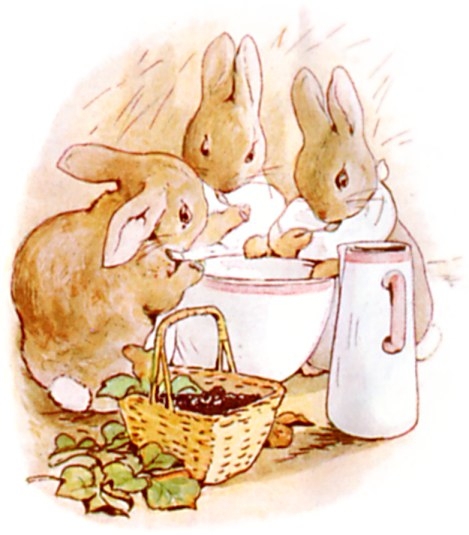


We have been getting very good blackberries lately and it came to my mind to give this old idea a try. Here is my bowl:


OK, it is a sandwich only by the loosest definition, bread + other. Or I could say it is a deconstructed sandwich. Or I could just say it was so delicious I will be having it again this morning for breakfast.


I must tell also tell you about one of my favourite Instagram accounts: Eating Their Words. Virginia is actually from Toronto and lives very near to my husband's hometown of Pesaro in Italy, of all things! She makes and serves all kinds of foods out of the books she reads, and posts beautiful pictures of the food and the cover together with the relevant quotation from the book. Check it out @eatingthierwords.


I guess that might be about it for sandwiches. The marigold is wondering nervously if it is still too early for lunch...


Friday, October 25, 2013

Pinterest is the new Vogue, or How I Spent My Summer Vacation


                               VS


For a long time I have wondered about fashion and magazines and reading time and beautiful photography and prices and old media versus social media and also what to wear today. All these concerns intersect in my world.

So - for starters, if you are reading books, you don't have time to read magazines and vice versa. That's hard for me, right there.


Then, the fancy fashion magazines are great for photography, but don't really help you decide what kind of shoes to get this fall, and when they do indicate what kind of shoes to get this fall, I find I am not keen to spend the $950 it takes to get them. (These are Gucci, and they are great, I must say, but who is able to afford that? How can one follow advice to buy these?) 


And also, I don't care what any fashion magazine has to say about issues. Not any issues: not clitorectomies; not body image; not art: not arts funding; not what men want; not how women combine work and motherhood; not what Michelle Obama is wearing today. Can you honestly say you care? I'd rather read about what Elizabeth Bennet is wearing, or Katniss, or Frankenstein's monster.


(Worth it, right?)

NOT ANY ISSUES. Actually, this is my main media concern, social and otherwise. I don't care what any people I DON'T KNOW think about any ISSUE. It's boring.

I once read (probably) that the reader is the product sold by the publication to the advertiser. Check that again. The READER is the PRODUCT SOLD BY the PUBLISHER TO the ADVERTISER. True. Also true for all televison, and quite certainly some movies and books. If that does not disembowel one's respect for content, nothing can. It's a frame as old as Latin: Cui bono? Who benefits?

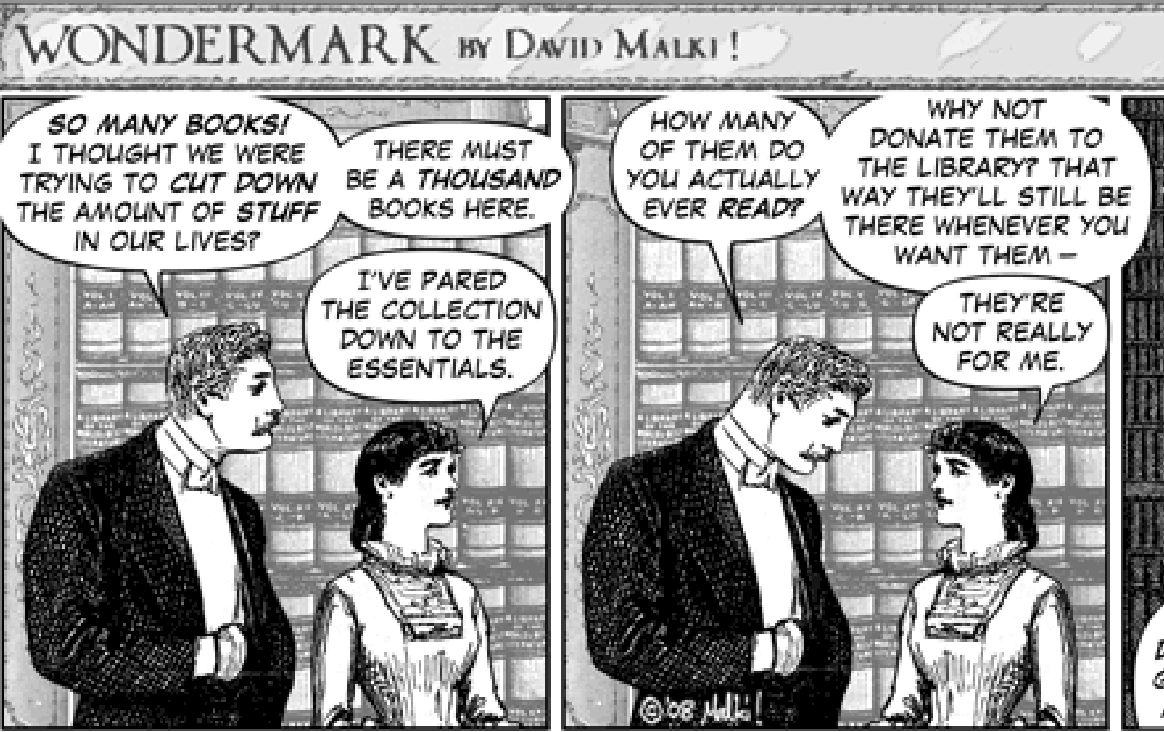
When I was a kid, I loved magazines, started at 13 with Seventeen magazine, (I actually remember this cover), graduated to Vogue and the New York Times Sunday edition at 16. I have had to continually edit my collection of torn-out reference pages to bring it back to relevant and also to prevent drowning accidents. See comic below.


I've posted this brilliant Wondermark comic before, and I will help my children mutate to live as bibliophibians but not as ... uh ... magazinophibians ... journophibians ... cartophibians...I think you get my drift.

But for the past 10 years I have increasingly felt a gap in the area of my brain that used to derive pleasure from following fashion in magazines. I still love clothes - love designers - love buying clothes (and art) from artisans who are not only theorizing but touching and making the product with their own hands. But magazines...nada. A couple are OK–Lucky and LouLou come to mind–practically no stories, affordable realizable fashion, but they still have pages and pages and pages that are not interesting to me, like all that advertising which is really what pays the bills. The entry price of the magazine is to provide tangible proof to the advertiser that future consumers of their product will actually see the ad. And now even they can hardly give them away on paper. (I mean, a $3 subscription?)


That brings us to the solution: Pinterest. I follow both these magazines on Pinterest.


I sell Pinterest to all my friends as a magazine you curate yourself. Curation is the buzzword of culture these days, and here it is again. I find streams and content that sync well with my tastes and interests. It flows past easily, and in 2 seconds I can fish out content and place it an organizational structure that has meaning for me. (Funnily, tagging is not part of it. Pinterest is for visual people, not book people. Words are not important. Images must be repinned to appear in two places, advantage is not taken of the infinite ability of one image to appear via its tags in 20 categories – actually the board IS the tag.)

Pinterest has revitalized the fun of getting dressed in the morning, of shopping for white jeans, of checking thru my mother's jewellery box for vintage brooches. It makes it feel cool to support and celebrate a local designer with little media presence...without the time-wasting of pages full of ads, full of current-paradigm issues, full of commentary, full of images for the otherwise inclined.

Plus, it gave me the nerve to buy spray paint for some storage tins, and make a small macro photography studio, and find the right glues to properly repair things around the house, and make little presents with my kids by hand...

In addition (she lectures on and on) Pinterest is safe - populated mainly by non-predators (shall we say); the social contact is actually minimal as there is little or no chat space; the social and political content is negligable. I don't worry about my kids collecting pictures of hedgehogs, or dollhouses. They may run into the f-word or tatts or men's chests, but that's about the limit. We can talk about it. They won't be shocked.

Finally, there are some fun infographics about what good business it is to appear on Pinterest - more click-thrus to purchases than on any platform, more time spent per user, more actions per user etc and this compared to Tumblr (OK) Facebook (bleh!) and Twitter (bleh!), for example. It's the new asses-in-seats, and I recommend you get it while it's hot.

The marigold wonders nervously if she should include links to said infographics? They change all the time, and the summary is stated...

Monday, August 19, 2013

Pajama Press Review or A Fabulous Tudor Moment


Namesake
By Sue MacLeod
Published by pajama press, 2013


I seem to be having a Tudor moment: a moment in which I am thinking about the place of Henry VIII in the development of Protestantism.


My readers know I ADORE the BBC show Horrible Histories, generated out of the book series by Terry Deary. Among the many importantly repeated characters is Henry VIII, (played by my favourite member of the comedy troop, Ben Willbond. Sigh.) I always get to watch it extra during the summer months. Less homework, you know.


Then, as a silver lining for a long summer in a foot cast (which goes with an even longer story, which I will tell you all about some other time) I got around to a couple of projects that needed some quiet time. I watched Simon Schama’s BBC video series History of Great Britain (he’s another of my heartthrobs). An entire episode was devoted to Thomas Cromwell, who was, for a significant period, a chief advisor to King Henry VIII, although he was one of many during Henry’s long reign.


As it happens, I was also just then reading Wolf Hall and Bring Up the Bodies, by Hilary Mantel, also about Thomas Cromwell. Mantel gives Cromwell as a Protestant of ardent personal belief, who masterfully supports and exploits Henry’s turn away from Rome. Although the wish to annul his marriage to Catherine of Aragon was a motivation, it can also be seen as a flashpoint. It highlighted the power of a foreign Pope over the English monarchy and succession, and came at a time when there were other protestant ideas swelling around Europe: to have bibles in the languages of the people which would allow all to access its message; a general disgust at the corruption of the old Catholic system, with some monks and nuns living in inappropriate luxury and abandon (not to mention priests, bishops, cardinals and Popes); the proliferation and sale of relics; and worst of all, the sale of indulgences.


To have a laugh about it all, watch this video from HH: It’s Your Reign, Henry VIII in which past friends and advisors of Henry are brought in to reminisce about their old times together.


Quite incidentally, I also recently watched and loved the Michael Wood documentary from PBS In Search of Shakespeare, which also centred on the struggle between the “old faith” or Roman Catholicism and the “new”, which became Anglicanism, a struggle that continued to play out throughout the reigns of Henry’s children, Catholic Mary and Protestant Elizabeth, and thus very importantly over the career of Shakespeare as well. I had never EVER thought about Shakespeare in terms of his personal political position on faith, and Woods’ research was stunning and fascinating. Just think of Romeo and Juliet in terms of the quarrel over religion and maybe your world will be as rocked as mine was. 

It was a stroke of good fortune that I received a copy of Namesake to review right when I was in the zone to appreciate it. The premise is effective and intriguing: a current high school student (like my kids), whose name is Jane Grey, somehow finds a small, illuminated, Book of Prayre among the library books she has taken out to prepare an AP History project on Lady Jane Grey.

The two Janes are linked not only by name, but also by the need for a refuge from the difficulties of their lives. Lady Jane Grey is awaiting beheading in the Tower of London for treason. She had been pushed into occupying the English throne as a Protestant for nine days on the death of her cousin, Henry VIII’s sickly young son Edward VI, until the Privy Council reinstated the more proper claim of his sister, the Catholic Mary. Modern Jane Grey lives with her alcoholic and unpredictable single mother, a university professor, who is going through the painful end of yet another romance. When each of the Janes turns to the prayer book for peace, they connect through time!

One of the main themes of Namesake is the struggle between Mary with her Catholic supporters and the mass of people already devoted to a more Protestant practice. Lady Jane follows the new faith. She maintains her faith loyally, and although she acquits herself well in discussion with a priest sent by Mary to bring her back to Catholicism, she declines to revert and thereby save her own life, choosing an honest and honourable death. Pretty rich for a YA book, which is ostensibly about teen-age troubles.

There is simply nothing I love more than offering some real, well-researched, history to kids, through a vehicle that engages them. Not at every minute in my life could I have felt as comfortable with the historical reality in this book, so how very fortunate it came to me just now.  I loved it, and I will be recommending this book anywhere I can, to any kids, teachers and libraries I encounter.


Sunday, August 18, 2013

LibraryThing Early Review


Hijacked: How Your Brain is Fooled by Food
by David A. Kessler MD,
Young Readers Edition adapted by Richie Chevat
from The End of Overeating
Tundra Books, 2013

This is an adapted version for kids, and, sadly, it feels like it was adapted by the "rules" method rather than ability to communicate with kids, with bullet point shout-outs, and breaks in the text. The ideas here are quite interesting, although, like many (if not nearly all) non-fiction books, it should actually just be a long article, as there is too much repetition used to flesh it out to book length. I can only imagine the grown-up version is even worse, with more anecdote and more repetition. (Should I say that again?)

The one key idea is that foods offered by industry with the magic fat:sugar:salt trio are nearly impossible to resist, especially, but not only, if you are not blessed by an inborn ability to govern your appetite. This is an idea to talk with kids about, and teaching my kids to mind themselves and have respect for the temple which is the body feels to me like one of my main jobs as a parent.

My mother is a dietitian, and I am a little jaded about food science, and a bit of a know-it-all, too, but even I was surprised by the fact that processed food is designed to be chewed and swallowed faster SO YOU EAT MORE. I imagine that just pure knowledge of this, and observing it next time we eat something processed, will help move my kids' tastes a little bit back toward food from processed food.

I was also interested to be tuned into the idea that a cute and clever way food companies get around the obligation to list ingredients by amounts is to break up "sugar" into brown sugar, honey, high fructose corn syrup and so on, so each one appears as a much less important part of the food, rather than showing us as a single dominant mass at the top of the list. Food label reading is something we do, especially of breakfast cereals, but I think we might read together labels on bread and ketchup to share that thought and increase our awareness.

I was also interested to think about the paradigm of "eatertainment" used by the restaurant industry, and this is certainly a weakness of mine, rather than that of a fussy kid. Not just a hot dog, but 12 varieties of hot dogs, with exotic topping. And what about serve yourself fro-yo in a dozen flavours to be added to your cup. (Have you seen the shock on faces at the cash register when the fro-yo cups are weighed for payment? There should a calorie counter by weight, too.)

The question is, if your kids are not already fighting a weight battle, which has its own motivations, will knowledge be sufficient to retrain their tastes? I will be following some of the suggestions in the book's final section, "Food Rehab", and I was glad to see exercise there as a twin pillar of food management. We'll see. Knowledge is power, and governing one's appetite is a life-long part of good health, so worth some effort and valuable in any quantity.


I keep a few food-health books handy in the kitchen for reference and recipes, The South Beach Diet (for heart health as well as weight control) by Arthur Agatson


and Ultimate Foods for Ultimate Health: But Don't Forget the Chocolate, by my friend Liz Pearson and her friend Marilyn Smith. This little book will join them so we can check things out right as they occur to us.

Saturday, April 7, 2012

LibraryThing Early Review

Pazuzu's Girl
by Rachel Coles

Although the name is not catchy, this book definitely is! The story of a mortal-ish daughter of an ancient god has been done - think Neil Gaiman, think Rick Riordan - this was still original enough to read and enjoy, And...a character in the book is a D&D player who recognizes Pazuzu, (and the antagonist, Lamashtu, his "ex-wife") lifted into the book and into Dungeons and Dragons from ancient Assyrian and Babylonian mythology, so the title itself may actually attract some readers.

I found some of the writing quite awkward, and some of the exegeses into politics a little under-developed and unnecessary both, but I think it could be suitable for editing and publishing at a different quality. (I'm thinking of the Trylle trilogy by Amanda Hocking here.)

It also began to feel like a gaming environment, with the names and alternate names and overlaid histories, and world-wide geography. Having read and loved ReamDe by Neal Stephenson, I have a new appreciation for that part of culture, which is not my home, and I think the feeling of traveling there in this book was part of its appeal for me.

And although the title character is a teen-aged girl, and the book indicated as Young Adult, one of my categories of interest, there is really nothing that restricts this book to kid readers, which is another pleasure. YA literature is often so programmatic, trying to teach thru a fictional setting, hitting a matrix of Politically Correct qualities, and this book had none of that vibe.

Once again, the very convenience of having the e-book version on my phone was a pleasure, and the book kept me great company while I was spending a lot of time in waiting rooms without my own stuff. After the last couple of e-book duds, it was refreshing to find a little unexpected nugget of quality. The proof of the pudding is in the eating, and looking at a phone full of writing and games, I chose to keep reading Pazuzu's Girl. There you go! Uptwinkles!

Book bonus feature: some cute attention to the world of butterflies, if you like that kind of thing.  Which I do. Needless to say. Then why am I saying it?

Thursday, December 8, 2011

Thumbnails of the hot Young Adult book series: A Primer for Grown-Ups


OK - I have been reading the hot kids' series along with my kids, and I realized I could help other parents at Christmas time by providing an easy-to-use reading list covering the biggest book series that everyone is talking about, and answering questions such as what are their strengths and weaknesses? will it be good for you? and what about the movie? Plus, you will be able to "Talk About Books You Haven't Read" in an appropriate way. (See my post on Pierre Bayard's fantastic How-To book by that name here.)

In more-or-less chronological order of the first book published in the series:


Harry Potter by JK Rowling (1998)
            Read: 4/7 (so far)   We began reading these because we had started watching the movies, and after reading some of the books, and seeing all of the movies, I find that although the books are naturally more complete, the movies don't miss much that is essential. We periodically reviewed the movies, when it was time to watch a new one, and we always enjoyed noticing something new, which is a good sign.
                            The Harry Potter books are excellently plotted, strong on character, but not so literary, although I can proudly say my 10-year old pointed out a Macbeth-like feeling to Voldemort. I am still reading thru the series with my younger kid. My older one read about half the books, but in reverse order, to the annoyance (or fury, apparently) of enthusiast-friends. I am an admirer of Snape, so I can't wait to get to book six, The Half-Blood Prince, to catch up on his back-story.We have also bought a couple of the books about Harry Potter which we all rummage around in. The books in this series are worth the time they take. Good enough for anyone to enjoy reading. (Duh!)


A Series of Unfortunate Events by Lemony Snickett   (1999)
             Read: 2/13   Loved the movie - it really allowed Jim Carrey to maximize his abilities. I wish there had been more outtakes, as he riffed on the uncle, Count Olaf, a character he was born to play.
            The books were fun at first, the language and voice are very interesting, and this was one of the first of the huge hit series, but it got old fast. Neither of my kids took them up. The series is now old and weak, but it helped establish the category, and I felt it ought to be here.


Percy Jackson and the Olympians by Rick Riordan  (2006)
            Read: 1/5   LOVED the movie, which we saw before trying the books, and it is one of my kids' all-time favourites. It's charming, and the actors are cute.
           I wanted to like the books a lot, as I love the idea of extending Greek mythology into our era, (grown-ups: you must read American Gods by Neil Gaiman if you like this idea) but I couldn't be roused to read past the first one. Somehow, I FOUND THE BOOKS BORING! Older kid also liked, no loved, reading PJ,and read them all. My 10-year old would like to, but isn't quite there yet.


The Hunger Games by Suzanne Collins   (2008)
             Read: 3/3   The movie is being made now. I believe the trailer for this movie to be the most anticipated and most watched trailer of all time. I thought it was pretty much kids, but many of my adult friends SENT ME A LINK to the trailer to make sure I saw it, too. And it looks pretty good, I must say.
            In my opinion, this is the best of all the series, not only for plot and character, but it is literate and literary, too. It had been MANY years since I finished a book one night and HAD TO GET the next book the next morning to find out what happened. That was fun. They are such a perfect read for any adult as well that I never hesitate to recommend them. My then-12-year old was obsessed, for half a year, and I think they qualify as a first book-love.


Twilight by Stephanie Meyer (2008)
            Read: 1/4    The first book was at least 50% too long, repetitive and unnecessarily wordy. Get to the point already. The movie helped by cutting the action down to 1-1/2 hours of real time. I have managed to see the second movie, but I haven't bothered since, but I guess if I turned on the TV and one was on, I would watch. My then-12-year old felt the same in all respects.
                           On the other hand, and thanks Christabel, I recently read a review of Bella's character, Our Bella, Ourselves, written by Sarah Blackwell on a blog called The Hairpin which got me re-thinking my response.


Gone by Michael Grant (2008)
             Read: 1/4 published, fifth to be released soon, a sixth in the works. Surprisingly, no movie talk, but I imagine it is just a question of time.
             I wasn't too crazy about this when I read it, but it is my 13-year old's current obsession, so I promised to re-read Gone, then read the rest of the series. In fact, I also promised I would update my opinion on this list once I get going with them. So...Whip Hand, Fearless Leader, Little Pete, special powers, a place with no adults. Conclusion: must try Lord of the Flies (Golding) again.


City of Bones by Cassandra Clare  (2008) and Clockwork Angel (2011)
            Read: 4/4 and 1/2 (second book to be released in a couple of days!)
I really powered thru the first series, and then read the first one of the prequel series, too. Lots of fun. The characters are cute, and the New York City setting of our day is pretty cool and relates to our trips there. My now-13-year old was enthusiastic, and we will be trying to be in the store on Dec 6 for the release of the second book of the second series.


Maze Runner by James Dashner  (2010)
            Read: 1/3
Twilight for boys, oddly high emotional pitch, except the action is the manly withstanding of danger rather than crushing on vampire boys. Like Twilight, the book is way too repetitive and much longer than it ought to be. Movie is being shopped, natch. My kid was put off by my review.


Matched by Ally Condie (2011)
             Read 1/3, but only the first two are currently available.
I liked it because instead of a brutal, deadly, dystopian future, Matched cleverly shows our current social trends projected into an extremely benevolent future. Central planning is working perfectly, beautifully minding the health and happiness of all citizens, but individuals are left with virtually no choice at all. Even their healthful meals are delivered in perfectly controlled portions. The result is still dystopia. My kid didn't want to read yet another book in the category at this point, but I was convincing enough that it was worth it, that it got read, and we agreed.


Divergent by Veronica Roth  (2011)
             Read: 1/3
Only first book is available so far, with the second in the pipeline for pre-orders, and the third as yet un-named. I liked this book, even though I was at first expecting to be bored by another entry in the future dystopia category. The writer is notably young. The heroine is a Katniss*-style power-house, and the boys are quite interesting. My kid and I both grew to like it as we read on thru it.


These two are both graphic, and for younger kids:


Amulet by Kazu Kibuishi (2008)
            Read: 3/4 so far
For the younger set - very beautiful, very sad and dark, much MUCH more interesting than Bone, which was the first huge graphic novel series for kids. My younger kid loved this series so much, it got me reading them, too, but the older kid read them too.


Bone by Jeff Smith (originally 1995, re-issued in book form 2005)
            Read 2/9:
Its success with the under-10 set is inexplicable to me. The look is deliberately like Pogo, a comic of 50 years ago, the characters are mean, and their world is unfathomable. I didn't like it or get it, and I still don't understand if my kids did, how my kids did if they did and what they got or what they liked. And not just my kids read it and said they loved it. All kids read it and said they loved it, reluctant readers even. Go figure.

I do have to admit that there are a couple of big ones that my kids haven't picked up (possibly yet), but that if they do, I will want to share them, too:

Artemis Fowl by Eoin Colfer (2001)


Eragon by Christopher Paolini (2002)
There is a movie, but, strangely, I haven't seen it either.


The Bartimaeus Trilogy by Johnathan Stroud (2003)


As I prepared this list, I realized that the first two series are pretty old, but only one has held up (and made the author AND HER AGENT) reportedly richer than the queen. 2008 seems to have been a banner year, and some kind of category shift happened so that since then all books are tried as a start to a series, and 2011 seems to have been a strong year, too.

The marigold is wondering nervously if there are other series I should have mentioned...of course there are tons of other series, but are there some I should have known about, should have been reading? Just started The Knife of Never Letting Go by Patrick Ness - not that big, but quite good...fret...fret...

Bonus question: Is Cassandra Clare is a real person? There are some clues that make it seem as though she is actually the pen-name of a collective of writers who are pals in a writing group (including Libba Bray, Kelly Link, Holly Black...) Anyone got any ideas?

*Katniss, in case you have been in a dark cave and did not yet see the trailer, is the amazing female protagonist of The Hunger Games. Trailer is here.

OK - This just in: Knife of Never Letting Go was really terrific, a cut above, another whole category of original. Up-twinkles! Clockwork Prince is good, glad to be still following it.


Even later update: Now I have started reading Leviathan, by Scott Westerfield - Steampunk for boys, OK so far, and he has another set that goes, like ... Uglies ... Pretties ... I dunno ... Crazies? ... Zombies? I'll keep you posted.


Later still: My younger kid just started Magyk from the Septimus Heap series by Angie Sage, so I guess I'll be reading that pretty soon, too. Yay!