Search This Blog

Showing posts with label culture. Show all posts

Sunday, January 8, 2017

2016: The year of reading Scottish

I realized that 2016 was my year of reading Scottish when I closed out the year reading an Inspector Rebus  by Ian Rankin, a writer I often find myself reading over Christmas break.


It was also the year that Shakespeare’s Macbeth was played at the Stratford Festival, so I read the play itself over the summer, in a couple of versions. Lady Macbeth by Susan Fraser King was suggested to me at a bookstore in Stratford, and altho it was a bit historical fiction (romance)-y it was a deeply researched work, which aimed to show Lady Macbeth according to the actual historical record, rather than as a figure in a story aimed at James I of England, the Scottish James VI, who inherited the English throne from his cousin Elizabeth I and who had reasons to support his succession with popular works. 


I watched Braveheart, because Mel Gibson used Polanski’s version of Macbeth to inspire his movie, and I am hoping to watch Polanski’s Macbeth before the new year resumes. 


I read both the first volume of the memoirs of James McLevy, McLevy: The Edinburgh Detective and David Ashton’s The Shadow of the Serpent, from the fictional Inspector McLevy Mystery  Series. McLevy was a real detective working in Edinburgh at the turn of the 20th C, and is a lovely backgrounder to Ian Rankin, and these were the first books of the year. I read them in Kindle, and great hospital waiting room reading they were, too.


I also watched the Korean historical drama series  Moon Lovers/Scarlet Heart Ryeo, a succession story with many parallels to Macbeth in addition to the succession struggles, including the female use of soft power rather than legal or armed strength. It was a stunning window into a beautiful and ritualized world of Korea 1000 years ago.


That series connected thru to Margaret Drabble’s Red Queen, also based on a real person, a Korean queen whose real diaries exist in three original versions, and whose first English translators used Macbeth to illuminate the machinations she described. (That work is still on my to-read list.) This was my first Drabble. I tend to prefer the other sister, and I did also read an A.S. Byatt, The Game this year, and it was masterful, as expected. 


Shakespeare, if not specifically Macbeth, was also strong this year, starting with finally reading a book handed down to me by my mother, published in 1935, but still the ranking work on the subject: Caroline Spurgeon’s Shakespeare’s Imagery and What it Tells Us, with lists and handmade charts, and beautiful essays connecting Shakespeare’s imagery with his life and comparing his imagery to the imagery of other writers of the period. I also read Michael Wood’s Shakespeare, which was written to accompany his BBC series In Search of Shakespeare that I watched a year or two ago, and which really gave me some updated ideas about Shakespeare around his likely crypto-Catholicism. It was especially effective in requiring a re-think of Romeo and Juliet, handy to re-watch because that is the tragedy at Stratford this coming year!


I also finally got to A Thousand Acres by Jane Smiley, which is a very satisfying mapping of King Lear onto an American prairie farm, a stunning book which I overlooked during my year of reading Lear. For the record I did also read another alternate Romeo and Juliet, but it was not a favourite.

And in keeping with the dark wintery feel of Scotland, I read a couple of mysteries from melancholy places like Sweden and Vermont, and a very dark summery mystery by Cormac McCarthy, Outer Dark, which I am pretty sure is The Inferno. 


I reread Jane Eyre with one of my kids as mandatory summer reading, and was mightily impressed by the power of Jane as well as the power of Charlotte Bronte as a writer and moralist. I saw and felt why the book remains a generally-considered top 10 book in English. (Sadly, I did not actually read a first edition copy.)


The World’s Strongest Librarian by Josh Hanagarne was a huge favourite of the year. It is about a 6’7” weight-lifting Mormon librarian with Tourette’s. Oh and it’s a non-fiction memoir!


Dystopian fiction is still hanging in there with the Mandibles: A Family, 2029-2047 by Lionel Shriver. I read this in a reading group with a few of my high school classmates, and I preferred it to my own choice for that group, a book by Canadian writer Maggie Helwig, Girls Fall Down. 


Then there was my beautiful Slavic mermaid favourite by Michelle Tea, Girl at the Bottom of the Sea, the second in a series published by McSweeney's, and my other YA favourite of the year Carry On by Rainbow Rowell, a real piece of meta-fiction, the writer’s fan fiction version of the fan fiction created by a the main character in her book Fan Girl, who writes about a fictional piece of fiction…


The graphic non-fiction winner of the year is Alison Bechdel’s memoir Fun Home: A Family Tragicomic, I book I often recommend to people looking to get into graphic. Bechdel is also the source of the fabulous Bechdel test, which is a bar of acceptability reached if two named women characters can be onscreen in a movie without talking about a man.


The total books read was 50 of which 19 are on this list, not the highest count ever, but many really great books. Additionally connected are a film, a play IRL and on video, and a TV series. Eight books were by Canadian writers, eleven were fiction, two were memoirs, two were about Shakespeare.

Friday, October 25, 2013

Pinterest is the new Vogue, or How I Spent My Summer Vacation


                               VS


For a long time I have wondered about fashion and magazines and reading time and beautiful photography and prices and old media versus social media and also what to wear today. All these concerns intersect in my world.

So - for starters, if you are reading books, you don't have time to read magazines and vice versa. That's hard for me, right there.


Then, the fancy fashion magazines are great for photography, but don't really help you decide what kind of shoes to get this fall, and when they do indicate what kind of shoes to get this fall, I find I am not keen to spend the $950 it takes to get them. (These are Gucci, and they are great, I must say, but who is able to afford that? How can one follow advice to buy these?) 


And also, I don't care what any fashion magazine has to say about issues. Not any issues: not clitorectomies; not body image; not art: not arts funding; not what men want; not how women combine work and motherhood; not what Michelle Obama is wearing today. Can you honestly say you care? I'd rather read about what Elizabeth Bennet is wearing, or Katniss, or Frankenstein's monster.


(Worth it, right?)

NOT ANY ISSUES. Actually, this is my main media concern, social and otherwise. I don't care what any people I DON'T KNOW think about any ISSUE. It's boring.

I once read (probably) that the reader is the product sold by the publication to the advertiser. Check that again. The READER is the PRODUCT SOLD BY the PUBLISHER TO the ADVERTISER. True. Also true for all televison, and quite certainly some movies and books. If that does not disembowel one's respect for content, nothing can. It's a frame as old as Latin: Cui bono? Who benefits?

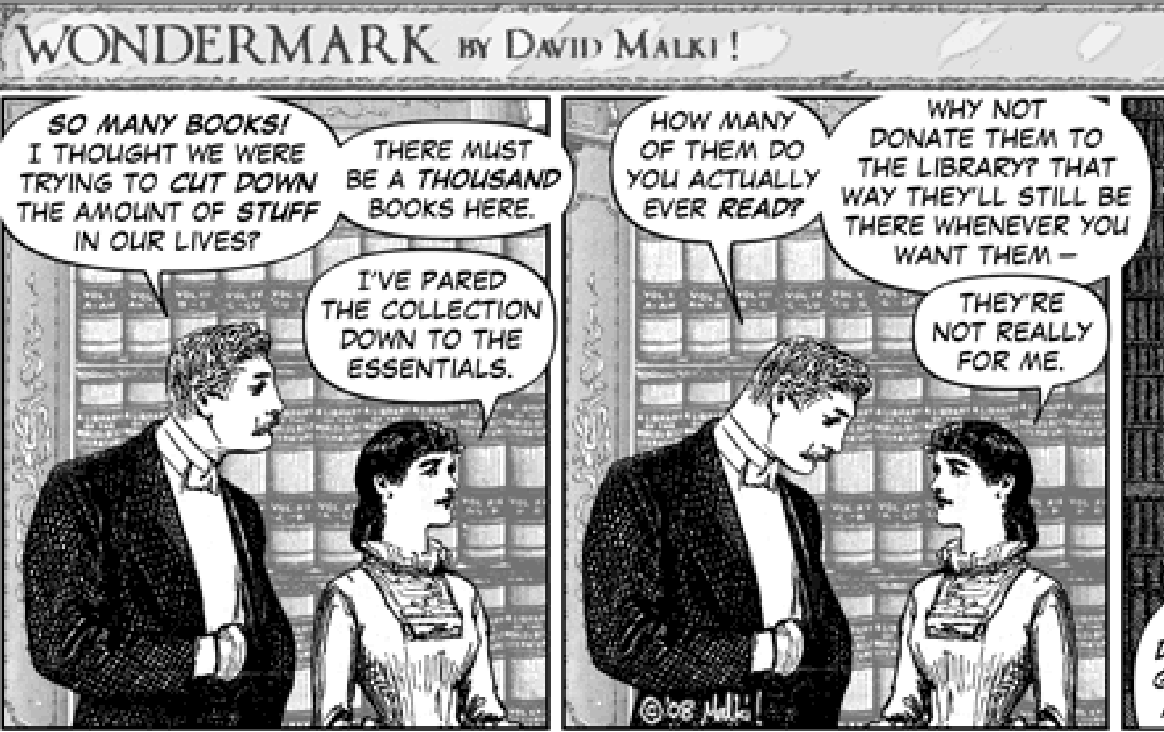
When I was a kid, I loved magazines, started at 13 with Seventeen magazine, (I actually remember this cover), graduated to Vogue and the New York Times Sunday edition at 16. I have had to continually edit my collection of torn-out reference pages to bring it back to relevant and also to prevent drowning accidents. See comic below.


I've posted this brilliant Wondermark comic before, and I will help my children mutate to live as bibliophibians but not as ... uh ... magazinophibians ... journophibians ... cartophibians...I think you get my drift.

But for the past 10 years I have increasingly felt a gap in the area of my brain that used to derive pleasure from following fashion in magazines. I still love clothes - love designers - love buying clothes (and art) from artisans who are not only theorizing but touching and making the product with their own hands. But magazines...nada. A couple are OK–Lucky and LouLou come to mind–practically no stories, affordable realizable fashion, but they still have pages and pages and pages that are not interesting to me, like all that advertising which is really what pays the bills. The entry price of the magazine is to provide tangible proof to the advertiser that future consumers of their product will actually see the ad. And now even they can hardly give them away on paper. (I mean, a $3 subscription?)


That brings us to the solution: Pinterest. I follow both these magazines on Pinterest.


I sell Pinterest to all my friends as a magazine you curate yourself. Curation is the buzzword of culture these days, and here it is again. I find streams and content that sync well with my tastes and interests. It flows past easily, and in 2 seconds I can fish out content and place it an organizational structure that has meaning for me. (Funnily, tagging is not part of it. Pinterest is for visual people, not book people. Words are not important. Images must be repinned to appear in two places, advantage is not taken of the infinite ability of one image to appear via its tags in 20 categories – actually the board IS the tag.)

Pinterest has revitalized the fun of getting dressed in the morning, of shopping for white jeans, of checking thru my mother's jewellery box for vintage brooches. It makes it feel cool to support and celebrate a local designer with little media presence...without the time-wasting of pages full of ads, full of current-paradigm issues, full of commentary, full of images for the otherwise inclined.

Plus, it gave me the nerve to buy spray paint for some storage tins, and make a small macro photography studio, and find the right glues to properly repair things around the house, and make little presents with my kids by hand...

In addition (she lectures on and on) Pinterest is safe - populated mainly by non-predators (shall we say); the social contact is actually minimal as there is little or no chat space; the social and political content is negligable. I don't worry about my kids collecting pictures of hedgehogs, or dollhouses. They may run into the f-word or tatts or men's chests, but that's about the limit. We can talk about it. They won't be shocked.

Finally, there are some fun infographics about what good business it is to appear on Pinterest - more click-thrus to purchases than on any platform, more time spent per user, more actions per user etc and this compared to Tumblr (OK) Facebook (bleh!) and Twitter (bleh!), for example. It's the new asses-in-seats, and I recommend you get it while it's hot.

The marigold wonders nervously if she should include links to said infographics? They change all the time, and the summary is stated...

Sunday, September 8, 2013

The Flying Creatures of Fra Angelico


By Antonio Tabucchi
translated by Tim Parks
Archipelago Books
2012


I have had a review copy of this book in PDF form for ages. It should have been a hot-button draw, but I just never seemed to feel like opening it on my desktop, despite its brevity. Finally, to clear up my obligation, I opened it, and found it delightful.

It seems that the writer, with  great sensitivity, wished to explore the imaginative space around certain historical objects, or episodes; he wanted to fantasize about the creation of art and history in a way that would feel like a real imaginative moment in the period. I found the little stories exquisite and evocative and delightful. Bravo. It is an exercise I enjoy, too, imagining the meetings in which movies are scripted, ads are planned, books are edited; imagining acts of imagination on their way to becoming realities.

I always try to capture my thoughts and impressions before researching or looking at other reviews. It was gratifying to realize that despite this book's appearance of being a self-published and self-indulgent effort, Tabucchi was actually a very respected academic and writer of literary fiction, and was nearly a contender for the Nobel Prize for Literature. This book was written about 25 years ago, and only pulled into English now.

Is it a coincidence that Tabucchi found his heart in Portugal, and that his post-modernism in these stories, many of which are set in Portuguese history, reminds me of Saramago? What is in the air/soil/food/water/wine of Portugal that fosters this art? My home language and culture is SO English, but I actually believe that literary art is happening elsewhere.

As someone always looking for a new thrill, I am pleased to have a new author to chase down and read through.

Now the marigold is wondering nervously about finding Tabucchi in a bookstore, about having this fixation with old guys writing about Portugal, about whether I should think up a thesis and aim for some sort of degree...

PS I have not yet found the shred of Fra Angelico that appears on the cover of the book, but I am looking. When I find it, I'll update this post.

Saturday, April 7, 2012

LibraryThing Early Review

Pazuzu's Girl
by Rachel Coles

Although the name is not catchy, this book definitely is! The story of a mortal-ish daughter of an ancient god has been done - think Neil Gaiman, think Rick Riordan - this was still original enough to read and enjoy, And...a character in the book is a D&D player who recognizes Pazuzu, (and the antagonist, Lamashtu, his "ex-wife") lifted into the book and into Dungeons and Dragons from ancient Assyrian and Babylonian mythology, so the title itself may actually attract some readers.

I found some of the writing quite awkward, and some of the exegeses into politics a little under-developed and unnecessary both, but I think it could be suitable for editing and publishing at a different quality. (I'm thinking of the Trylle trilogy by Amanda Hocking here.)

It also began to feel like a gaming environment, with the names and alternate names and overlaid histories, and world-wide geography. Having read and loved ReamDe by Neal Stephenson, I have a new appreciation for that part of culture, which is not my home, and I think the feeling of traveling there in this book was part of its appeal for me.

And although the title character is a teen-aged girl, and the book indicated as Young Adult, one of my categories of interest, there is really nothing that restricts this book to kid readers, which is another pleasure. YA literature is often so programmatic, trying to teach thru a fictional setting, hitting a matrix of Politically Correct qualities, and this book had none of that vibe.

Once again, the very convenience of having the e-book version on my phone was a pleasure, and the book kept me great company while I was spending a lot of time in waiting rooms without my own stuff. After the last couple of e-book duds, it was refreshing to find a little unexpected nugget of quality. The proof of the pudding is in the eating, and looking at a phone full of writing and games, I chose to keep reading Pazuzu's Girl. There you go! Uptwinkles!

Book bonus feature: some cute attention to the world of butterflies, if you like that kind of thing.  Which I do. Needless to say. Then why am I saying it?

Wednesday, January 18, 2012

Special Music Issue - Just to Share


I was hearing this song, and loving it, (thanks to Afrouz) and I finally took the time to find it on YouTube. The fun thing is that they are a DJ and singer from Montreal/Toronto, and the sad thing is that they are no longer together. The song is awesome. There are these two great videos that go with it: the first one won a contest to be the official video for the song, but the other is also cute and good for sharing with a general audience. There appear to be more videos of this song, plus remixes and all kinds of other cool Thunderheist songs, but you can just go search them on YouTube on your own!


The marigold wonders if it would be useful as a status message on Facebook or BBM or whatever: I am dusting it off and jerking it. Maybe not. I think it would make me nervous.

Sunday, December 25, 2011

The New Neologisms Club


a delicious and inspiring fragment from
Wondermark
by David Malki!

 (check the link under FUN, COOL, FUNNY)


I had this quick thought, here amid the preparations for Christmas. I love the ability of English to generate new words. Actually, I love English for a lot of things, but one of them is certainly the spontaneous and welcome generation of new words. I even love the the word "neologism".

I recently wrote 'common-sensical' in an email, and the 'sensical' part came up with a spell-check underline, as it is right now in Blogger. I checked 'sensical', which did sound strange alone, and got, from Wiktionary (oh yeah!) that it is a neologism, used to make other a 'sense'-oriented adjectives, back-formed from 'nonsensical'. Of course. Perfect.

And then I wanted to write 'calendarize', a word I love to use, and feel as though I coined. Oh no, I di'n't! (Is that right for that funny way of saying it?) Wiktionary had that too, and this is where is English is so kewl  (note to self, send out tweet: OMG English is kewl). Calendarize is a perfectly recognizable neologism, which English readily permits, turning a noun into a verb and vice-versa.

So one thing I love about English is neologisms, and the other thing I love is the flexibility of English pronunciation and I also love the irregularity, oh wait, among the many things things I love are neologism, flexibility of pronunciation and the irregularity of its spelling, which permit jokes, puns and neologisms that are easily communicated and understood: Thus 'common-sensical', 'calendarize' and 'kewl'.

I challenge any other language on earth to offer such openness such newness (oh wait, there's an old word for that: novelty - sorry). Bring it!

PS Thanks Alison - I never thought of making it a club! So fun! You are all welcome to join and feel free to send in your favourites.

Oh dear. Now the marigold is wondering nervously if anyone will join the club. Oh no! The magic eight-ball says "very doubtful": Yes, that's for you, too, Alison. And what should the annual dues be? I guess it doesn't matter.

Thursday, December 8, 2011

Thumbnails of the hot Young Adult book series: A Primer for Grown-Ups


OK - I have been reading the hot kids' series along with my kids, and I realized I could help other parents at Christmas time by providing an easy-to-use reading list covering the biggest book series that everyone is talking about, and answering questions such as what are their strengths and weaknesses? will it be good for you? and what about the movie? Plus, you will be able to "Talk About Books You Haven't Read" in an appropriate way. (See my post on Pierre Bayard's fantastic How-To book by that name here.)

In more-or-less chronological order of the first book published in the series:


Harry Potter by JK Rowling (1998)
            Read: 4/7 (so far)   We began reading these because we had started watching the movies, and after reading some of the books, and seeing all of the movies, I find that although the books are naturally more complete, the movies don't miss much that is essential. We periodically reviewed the movies, when it was time to watch a new one, and we always enjoyed noticing something new, which is a good sign.
                            The Harry Potter books are excellently plotted, strong on character, but not so literary, although I can proudly say my 10-year old pointed out a Macbeth-like feeling to Voldemort. I am still reading thru the series with my younger kid. My older one read about half the books, but in reverse order, to the annoyance (or fury, apparently) of enthusiast-friends. I am an admirer of Snape, so I can't wait to get to book six, The Half-Blood Prince, to catch up on his back-story.We have also bought a couple of the books about Harry Potter which we all rummage around in. The books in this series are worth the time they take. Good enough for anyone to enjoy reading. (Duh!)


A Series of Unfortunate Events by Lemony Snickett   (1999)
             Read: 2/13   Loved the movie - it really allowed Jim Carrey to maximize his abilities. I wish there had been more outtakes, as he riffed on the uncle, Count Olaf, a character he was born to play.
            The books were fun at first, the language and voice are very interesting, and this was one of the first of the huge hit series, but it got old fast. Neither of my kids took them up. The series is now old and weak, but it helped establish the category, and I felt it ought to be here.


Percy Jackson and the Olympians by Rick Riordan  (2006)
            Read: 1/5   LOVED the movie, which we saw before trying the books, and it is one of my kids' all-time favourites. It's charming, and the actors are cute.
           I wanted to like the books a lot, as I love the idea of extending Greek mythology into our era, (grown-ups: you must read American Gods by Neil Gaiman if you like this idea) but I couldn't be roused to read past the first one. Somehow, I FOUND THE BOOKS BORING! Older kid also liked, no loved, reading PJ,and read them all. My 10-year old would like to, but isn't quite there yet.


The Hunger Games by Suzanne Collins   (2008)
             Read: 3/3   The movie is being made now. I believe the trailer for this movie to be the most anticipated and most watched trailer of all time. I thought it was pretty much kids, but many of my adult friends SENT ME A LINK to the trailer to make sure I saw it, too. And it looks pretty good, I must say.
            In my opinion, this is the best of all the series, not only for plot and character, but it is literate and literary, too. It had been MANY years since I finished a book one night and HAD TO GET the next book the next morning to find out what happened. That was fun. They are such a perfect read for any adult as well that I never hesitate to recommend them. My then-12-year old was obsessed, for half a year, and I think they qualify as a first book-love.


Twilight by Stephanie Meyer (2008)
            Read: 1/4    The first book was at least 50% too long, repetitive and unnecessarily wordy. Get to the point already. The movie helped by cutting the action down to 1-1/2 hours of real time. I have managed to see the second movie, but I haven't bothered since, but I guess if I turned on the TV and one was on, I would watch. My then-12-year old felt the same in all respects.
                           On the other hand, and thanks Christabel, I recently read a review of Bella's character, Our Bella, Ourselves, written by Sarah Blackwell on a blog called The Hairpin which got me re-thinking my response.


Gone by Michael Grant (2008)
             Read: 1/4 published, fifth to be released soon, a sixth in the works. Surprisingly, no movie talk, but I imagine it is just a question of time.
             I wasn't too crazy about this when I read it, but it is my 13-year old's current obsession, so I promised to re-read Gone, then read the rest of the series. In fact, I also promised I would update my opinion on this list once I get going with them. So...Whip Hand, Fearless Leader, Little Pete, special powers, a place with no adults. Conclusion: must try Lord of the Flies (Golding) again.


City of Bones by Cassandra Clare  (2008) and Clockwork Angel (2011)
            Read: 4/4 and 1/2 (second book to be released in a couple of days!)
I really powered thru the first series, and then read the first one of the prequel series, too. Lots of fun. The characters are cute, and the New York City setting of our day is pretty cool and relates to our trips there. My now-13-year old was enthusiastic, and we will be trying to be in the store on Dec 6 for the release of the second book of the second series.


Maze Runner by James Dashner  (2010)
            Read: 1/3
Twilight for boys, oddly high emotional pitch, except the action is the manly withstanding of danger rather than crushing on vampire boys. Like Twilight, the book is way too repetitive and much longer than it ought to be. Movie is being shopped, natch. My kid was put off by my review.


Matched by Ally Condie (2011)
             Read 1/3, but only the first two are currently available.
I liked it because instead of a brutal, deadly, dystopian future, Matched cleverly shows our current social trends projected into an extremely benevolent future. Central planning is working perfectly, beautifully minding the health and happiness of all citizens, but individuals are left with virtually no choice at all. Even their healthful meals are delivered in perfectly controlled portions. The result is still dystopia. My kid didn't want to read yet another book in the category at this point, but I was convincing enough that it was worth it, that it got read, and we agreed.


Divergent by Veronica Roth  (2011)
             Read: 1/3
Only first book is available so far, with the second in the pipeline for pre-orders, and the third as yet un-named. I liked this book, even though I was at first expecting to be bored by another entry in the future dystopia category. The writer is notably young. The heroine is a Katniss*-style power-house, and the boys are quite interesting. My kid and I both grew to like it as we read on thru it.


These two are both graphic, and for younger kids:


Amulet by Kazu Kibuishi (2008)
            Read: 3/4 so far
For the younger set - very beautiful, very sad and dark, much MUCH more interesting than Bone, which was the first huge graphic novel series for kids. My younger kid loved this series so much, it got me reading them, too, but the older kid read them too.


Bone by Jeff Smith (originally 1995, re-issued in book form 2005)
            Read 2/9:
Its success with the under-10 set is inexplicable to me. The look is deliberately like Pogo, a comic of 50 years ago, the characters are mean, and their world is unfathomable. I didn't like it or get it, and I still don't understand if my kids did, how my kids did if they did and what they got or what they liked. And not just my kids read it and said they loved it. All kids read it and said they loved it, reluctant readers even. Go figure.

I do have to admit that there are a couple of big ones that my kids haven't picked up (possibly yet), but that if they do, I will want to share them, too:

Artemis Fowl by Eoin Colfer (2001)


Eragon by Christopher Paolini (2002)
There is a movie, but, strangely, I haven't seen it either.


The Bartimaeus Trilogy by Johnathan Stroud (2003)


As I prepared this list, I realized that the first two series are pretty old, but only one has held up (and made the author AND HER AGENT) reportedly richer than the queen. 2008 seems to have been a banner year, and some kind of category shift happened so that since then all books are tried as a start to a series, and 2011 seems to have been a strong year, too.

The marigold is wondering nervously if there are other series I should have mentioned...of course there are tons of other series, but are there some I should have known about, should have been reading? Just started The Knife of Never Letting Go by Patrick Ness - not that big, but quite good...fret...fret...

Bonus question: Is Cassandra Clare is a real person? There are some clues that make it seem as though she is actually the pen-name of a collective of writers who are pals in a writing group (including Libba Bray, Kelly Link, Holly Black...) Anyone got any ideas?

*Katniss, in case you have been in a dark cave and did not yet see the trailer, is the amazing female protagonist of The Hunger Games. Trailer is here.

OK - This just in: Knife of Never Letting Go was really terrific, a cut above, another whole category of original. Up-twinkles! Clockwork Prince is good, glad to be still following it.


Even later update: Now I have started reading Leviathan, by Scott Westerfield - Steampunk for boys, OK so far, and he has another set that goes, like ... Uglies ... Pretties ... I dunno ... Crazies? ... Zombies? I'll keep you posted.


Later still: My younger kid just started Magyk from the Septimus Heap series by Angie Sage, so I guess I'll be reading that pretty soon, too. Yay!