Oh my goodness. This weekend I read a couple of books I wanted to record for my 2014 favourites list. And when I opened my Blogger account, I realized I had never completed and posted my 2013 list! Here it is at last! All ready to go, and just waiting there, in the interwebs, alone and unloved.
Somehow, 2013 was not a brilliant year for reading, but there were a few good ones:
I read a few must-reads, and found them formulaic. Step forward:
David Levithan for Every Day
and Rainbow Rowell for Eleanor and Park.
These two books actually made me realize that the teen-age-outsider-romance genre is offically over-mined. The books can be cute and readable. Most YA fiction is strong on plot and character, and goes down easily, but, like hamburgers compared to filet, often wolfed in a hurry; cheap, but even at the price still too many calories for the nourishment provided.
I read a book I expected to be formulaic, and actually copied a quotation to carry around in my device: Step up Anne Tyler for Back When We Were Grown-ups.
I've written separately about my fabulous Tudor moment this summer, featuring, in part, Wolf Hall and Bring up the Bodies by Hilary Mantel,
and, Namesake by Sue McLeod (in YA, from Pajama Press, a little starlet of Canadian publishing). All great books that make this list.
I did find two graphic efforts quite superior to almost anything I've ever read in the category:
Laika by Nick Abadzis, from 1st Second–possibly the best graphic publishing house on earth. Laika is a fictionalized, graphicized version of the Soviet space program sending Laika the dog into space. Real characters and timelines. Graphic images that brought an extra dimension to the story that words could not. Not exactly beautiful, but SENSATIONAL. I cried through most of the book. My kids cried through most of the book.
Relish by Lucy Knisley is the second graphic memoir by Knisley. I also enjoyed her first, French Milk, and I have actually been reading graphic memoirs, and feel ready to judge among them. Her works are deft and engaging and suitable for the treatment.
I must mention that in my hall of fame as the one of best graphic works ever and best graphic memoir in particular, is Marisa Acocella'sCancer Vixen. So harsh and funny. And heart-breaking and funny. And gross and funny.
Staying with memoirs, one of my real favourite reads of this year, altho it took two tries to get it going, was Maphead: Charting the Wide, Weird World of Geography Wonks, by Ken Jennings. He is the guy who at one point had won the most money ever on Jeopardy. (Should I mention that my scrabble-master spouse and I have a secret plan, if we ever need money fast, that we will go to California, and he will go on Wheel of Fortune, and I will go on Jeopardy? No, uh, best keep it secret. Never mind. You remember nothing! *Waves hands spookily*) Jennings was also chosen to play against IBM's computer, Watson, and I realized that I really liked him when underneath his response during Final Jeopardy he wrote on his screen "I for one welcome our new computer overlords". In any case, as a slight geography wonk myself (surprised?) I loved reading all the way people indulge this passion, and I find myself relating stories from the book quite often. His writing style is so engaging, and he is so smart, but also so keyed to pop culture, that it was one of those reading experiences that are like talking to a great friend.
Over the past couple of years I have read a bunch, but a bunch, of laddish science fiction books. I think it is a kind of mini-genre. I found them funny at first, but they were so sophomoric, that despite a certain shock value–which is a quality I often go for–they became boring and many I could not be bothered to finish reading. I find my buddy Shelf Monkey has recommendations on LibraryThing for these books, one of which actually made it onto the list of best reads:
Charles Yu's How to Live Safely in a Science Fictional Universe, a super-fun story about how it is grammar which defines past and future, and therefore time travel is all about altering grammatical settings! Wow! Fun! I know, right? Love it!
On the list of laddish also-rans that still might be worth considering we have:
Corey Doctorow's The Rapture of the Nerds:A tale of the singularity, posthumanity, and awkward social situations.
I did abandon this book part way through. Love him so much I might get back to it.
Mark Leynor's Sugar Frosted Nutsack: A Novel. Just about unreadable.
David Wong's John Dies at the End
I did read it all. Apparently also coming as a major motion picture. Or something.
And that's it. The year that was.
The marigold does wonder nervously if all reading will become graphic at some point...?
For a long time I have wondered about fashion and magazines and reading time and beautiful photography and prices and old media versus social media and also what to wear today. All these concerns intersect in my world.
So - for starters, if you are reading books, you don't have time to read magazines and vice versa. That's hard for me, right there.
Then, the fancy fashion magazines are great for photography, but don't really help you decide what kind of shoes to get this fall, and when they do indicate what kind of shoes to get this fall, I find I am not keen to spend the $950 it takes to get them. (These are Gucci, and they are great, I must say, but who is able to afford that? How can one follow advice to buy these?)
And also, I don't care what any fashion magazine has to say about issues. Not any issues: not clitorectomies; not body image; not art: not arts funding; not what men want; not how women combine work and motherhood; not what Michelle Obama is wearing today. Can you honestly say you care? I'd rather read about what Elizabeth Bennet is wearing, or Katniss, or Frankenstein's monster.
(Worth it, right?)
NOT ANY ISSUES. Actually, this is my main media concern, social and otherwise. I don't care what any people I DON'T KNOW think about any ISSUE. It's boring.
I once read (probably) that the reader is the product sold by the publication to the advertiser. Check that again. The READER is the PRODUCT SOLD BY the PUBLISHER TO the ADVERTISER. True. Also true for all televison, and quite certainly some movies and books. If that does not disembowel one's respect for content, nothing can. It's a frame as old as Latin: Cui bono? Who benefits?
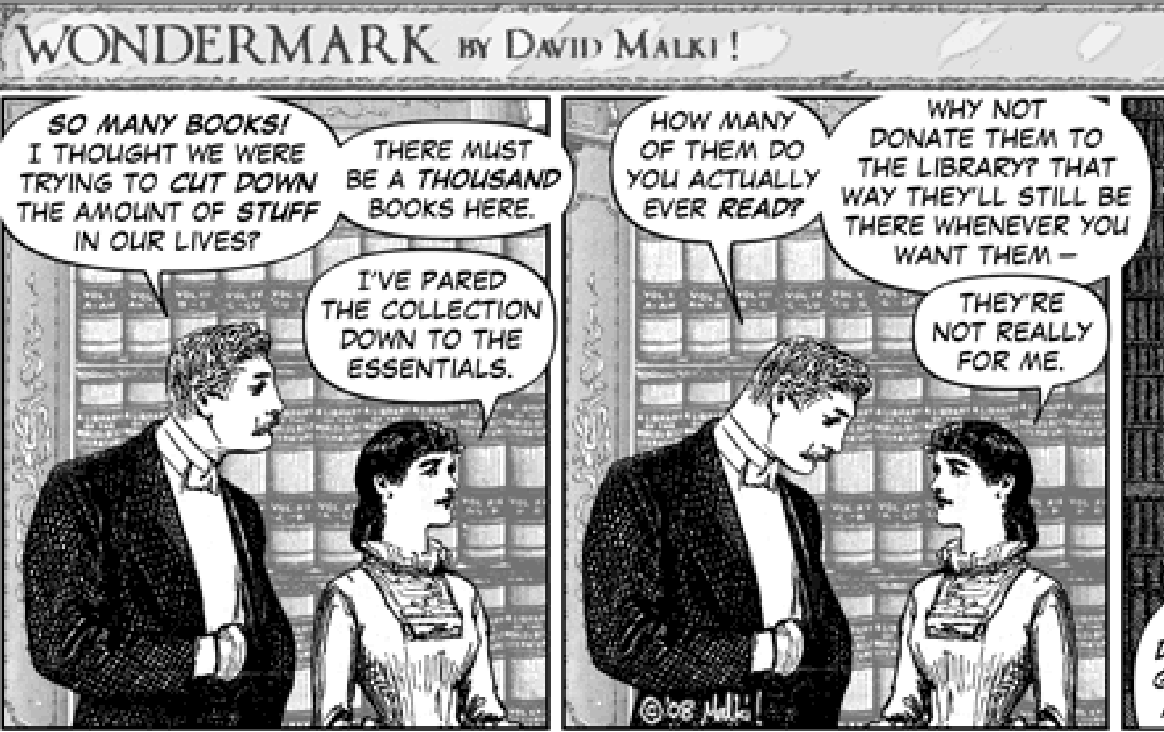
When I was a kid, I loved magazines, started at 13 with Seventeen magazine, (I actually remember this cover), graduated to Vogue and the New York Times Sunday edition at 16. I have had to continually edit my collection of torn-out reference pages to bring it back to relevant and also to prevent drowning accidents. See comic below.
I've posted this brilliant Wondermark comic before, and I will help my children mutate to live as bibliophibians but not as ... uh ... magazinophibians ... journophibians ... cartophibians...I think you get my drift.
But for the past 10 years I have increasingly felt a gap in the area of my brain that used to derive pleasure from following fashion in magazines. I still love clothes - love designers - love buying clothes (and art) from artisans who are not only theorizing but touching and making the product with their own hands. But magazines...nada. A couple are OK–Lucky and LouLou come to mind–practically no stories, affordable realizable fashion, but they still have pages and pages and pages that are not interesting to me, like all that advertising which is really what pays the bills. The entry price of the magazine is to provide tangible proof to the advertiser that future consumers of their product will actually see the ad. And now even they can hardly give them away on paper. (I mean, a $3 subscription?)
That brings us to the solution: Pinterest. I follow both these magazines on Pinterest.
I sell Pinterest to all my friends as a magazine you curate yourself. Curation is the buzzword of culture these days, and here it is again. I find streams and content that sync well with my tastes and interests. It flows past easily, and in 2 seconds I can fish out content and place it an organizational structure that has meaning for me. (Funnily, tagging is not part of it. Pinterest is for visual people, not book people. Words are not important. Images must be repinned to appear in two places, advantage is not taken of the infinite ability of one image to appear via its tags in 20 categories – actually the board IS the tag.)
Pinterest has revitalized the fun of getting dressed in the morning, of shopping for white jeans, of checking thru my mother's jewellery box for vintage brooches. It makes it feel cool to support and celebrate a local designer with little media presence...without the time-wasting of pages full of ads, full of current-paradigm issues, full of commentary, full of images for the otherwise inclined.
Plus, it gave me the nerve to buy spray paint for some storage tins, and make a small macro photography studio, and find the right glues to properly repair things around the house, and make little presents with my kids by hand...
In addition (she lectures on and on) Pinterest is safe - populated mainly by non-predators (shall we say); the social contact is actually minimal as there is little or no chat space; the social and political content is negligable. I don't worry about my kids collecting pictures of hedgehogs, or dollhouses. They may run into the f-word or tatts or men's chests, but that's about the limit. We can talk about it. They won't be shocked.
Finally, there are some fun infographics about what good business it is to appear on Pinterest - more click-thrus to purchases than on any platform, more time spent per user, more actions per user etc and this compared to Tumblr (OK) Facebook (bleh!) and Twitter (bleh!), for example. It's the new asses-in-seats, and I recommend you get it while it's hot.
The marigold wonders nervously if she should include links to said infographics? They change all the time, and the summary is stated...
By Antonio Tabucchi
translated by Tim Parks
Archipelago Books
2012
I have had a review copy of this book in PDF form for ages. It should have been a hot-button draw, but I just never seemed to feel like opening it on my desktop, despite its brevity. Finally, to clear up my obligation, I opened it, and found it delightful.
It seems that the writer, with great sensitivity, wished to explore the imaginative space around certain historical objects, or episodes; he wanted to fantasize about the creation of art and history in a way that would feel like a real imaginative moment in the period. I found the little stories exquisite and evocative and delightful. Bravo. It is an exercise I enjoy, too, imagining the meetings in which movies are scripted, ads are planned, books are edited; imagining acts of imagination on their way to becoming realities.
I always try to capture my thoughts and impressions before researching or looking at other reviews. It was gratifying to realize that despite this book's appearance of being a self-published and self-indulgent effort, Tabucchi was actually a very respected academic and writer of literary fiction, and was nearly a contender for the Nobel Prize for Literature. This book was written about 25 years ago, and only pulled into English now.
Is it a coincidence that Tabucchi found his heart in Portugal, and that his post-modernism in these stories, many of which are set in Portuguese history, reminds me of Saramago? What is in the air/soil/food/water/wine of Portugal that fosters this art? My home language and culture is SO English, but I actually believe that literary art is happening elsewhere.
As someone always looking for a new thrill, I am pleased to have a new author to chase down and read through.
Now the marigold is wondering nervously about finding Tabucchi in a bookstore, about having this fixation with old guys writing about Portugal, about whether I should think up a thesis and aim for some sort of degree...
PS I have not yet found the shred of Fra Angelico that appears on the cover of the book, but I am looking. When I find it, I'll update this post.
You may remember me writing about e-books way back in the summer of 2011, (here) that it was like over-indulging in junk food. I found that it was too true, and I was already past the point of satiation. Without the trap of time, spent with only a phone to read from (first travelling and then waiting around in a hospital waiting room), my appetite went down for reading indie e-books. However, I requested some ARCs of e-books from LibraryThing before I really realized it, and here are the reviews:
Things Falling Apart
by JW Schnarr
This one is OK - deft enough, but didn't make me desperate to get back to the stories. Dark, Canadian, random, fragmentary...not bad, but not that special.
Craving
by Kristina Meister
The premise is cool, the voice seemed believable, but I couldn't quite stay with it long enough to find out where it was going. I may be able to get back to this and fill out my impressions.
Twice Shy
by Patrick Freivald
The cover resembles my fashion look-book on Pinterest, funnily enough. Cute idea of zombies masked to pass as humans. Readable enough, but not something I find myself choosing when I have a choice of books.
I have stopped requesting new indie e-books to review. However...
ON the other hand, there is something which has driven me back to the world of public-domain classics that are available thru the miracle of the internet.
By this I mainly mean the BBC show SHERLOCK–I sort of feel like I'm part of the fandom, can't get enough, regularly rewatch episodes, getting excited by the approach of the 3rd season in November, and got REALLY excited by the announcement of a 4th season to come– but also including the two Guy Ritchie movies of the more historic Sherlock Holmes, breathe...
I happened upon a short group of Sherlock Holmes stories on my iPad. When I first went "i-" I naturally checked out all the reading resources. I have, and use, and regularly buy for, mainly Kindle, but I also have iBooks, Stanza, and Audiobooks which I hardly use, except to try their free classics, plus an app called Classics, plus a free+ app called Sherlock Holmes. For free it has only a small selection of 12 short stories, but how thrilling to go to the original text when teasing apart episodes of SHERLOCK, to find actual quotations that appear in one or the other, and I even found one of the title episodes.
It also got me wondering. Was Sir Arthur Conan Doyle a kind of genius or a popular phenomenon, a gifted hack or...what is the critical opinion, exactly? I recently heard of the rehabilitation of the composer Rachmaninoff and I am there with that. My childhood ears were filled with Tchaikovsky and Rachmaninoff and Puccini and, there but less so, Beethoven and my own first discovery, Dvorak. All super-easy superstars, sort of somewhat denigrated for their very ease of their popularity. I have always LOVED all of them, but as my music theory improved, I wondered if I loved them only for their childhood familiarity, if the music was simplistic. Needless to say, I was very pleased to hear, from Tom Allen on CBC 2 no less (see the link for his twitter feed on the sidebar) that Rach is being reconsidered as a composer, and shifted up somewhat from his lightweight class.
So, back to Conan Doyle, I am thinking of Adam Gopnik writing about Moby Dick in the The New Yorker in 2007, here, with the idea that works that would nowadays be "..., by conventional contemporary standards of good editing and critical judgment, improved..." are, in fact, hailed as genius because of their ideosyncratic irregularity.
Certainly merits some additional thought.
The marigold is wondering somewhat nervously about how one's reputation fares when one admits to liking the popular. What strength of character and reputation is required to be part of the movement towards critical acceptance rather than popular?
It's been a long time since I've worked here, for all the usual boring human reasons. But, I have been reading all along, and I have had some marvelous reading experiences in 2012–altho fewer by far than I have had the past few years– and that is not to mention the additional marvelous book-buying experiences this year has offered. So, here I am on Dec 21, and I have decided to celebrate that today is not, in fact, the end of the world by starting the reviewing and listing my favourite reads of the year.
(And here I am trying to finish up half-way thru February. Ah well. Nope. Finishing in March. The books were still good. Already found one or two for my 2013 list. )
In the number one position, by a long way, is a book so awesome that I think I may have caused a run on it in the local bookstores just by raving about it to all my reading friends:
Popular Crime: Reflections on the Celebration of Violence
by Bill James
(2011)
This is an extremely idiosyncratic book by a very smart guy. Reading it feels like talking with a bright friend. He already revolutionized baseball scouting by analyzing scouting practices as an outsider, and he has applied the same sort of pure rationality to the intersection of crime and media. He is not a lawyer or journalist or prison reform advocate or politician or...or...or. He is a smart guy. He has no vested interest. He has no agenda. I am so sad that I have finished the book. I wish it could have lasted longer. I am so attracted to his thinking that I am almost prepared to take up reading his baseball thoughts, even tho baseball is possibly lowest on my list of interesting sports. Well, perhaps basketball is...or rugby, erm, cricket...but anyway, this is a book I believe anyone could enjoy - from ardent readers of fiction to ardent readers of the newspaper.
Here are the rest of the books, in no particular order, fiction first, then the two non-fiction entries on the list.
Stormdancer
by Jay Kristoff
(2012)
Japanese Steampunk. With glossary. Bends the genre, and mashes it up. No more need be said.
Death and the Penguin
by Andrey Kurkov
(1996, first in English 2001, this edition 2011)
Post-glasnost Ukrainian fiction, black comedy, featuring a penguin. Horrifyingly real and funny.
The Wind-up Girl
by Paolo Baciagalupi (best name ever!)
(2009)
A fantastic projection into the future - commerce controlled by food barons, borders locked down to slow the spread of plant epidemics engendered by mono-culturing of agriculture, a sexy Japanese cyborg struggling with her conscience, while the humans around her live blithely day-to-day. No, not blithely; they endure, but they don't challenge. This was a masterpiece of science fiction as far as I am concerned. It stayed with me so much that I realized I better give it my "favourites" tag on LibraryThing.
The Learners
by Chip Kidd
(2008)
One of my literary heros, first he was a star of book cover design. This novel concerns Stanley Milgram's Obedience to Authority experiment at Yale, one of the (very) few things I truly learned in university, and a lesson that continues to resound in everyday life. It is also a book, if you are interested.
1Q84
by Haruki Murakami
(2009, in English 2011)
Murakami was a real favourite of mine, but then I read that his English editors shortened his works by 33%, thus, I guess, inadvertently enhancing the magical realism of his novels. I finally got past the idea when this book was recommended by a kid I admire, and I read it. It was Murakami; it was awesome.
Etymologicon
by Mark Forsyth
(2012)
From the title joke, to the last word, this book was a delight and a surprise even to a committed amateur etymologist such as myself. So thorough, so funny. Although there were some gaps that I could identify from knowing Italian, I didn't see any errors, and for that I give about 5 thumbs up! Forsyth has a wordy website, The Inky Fool, which is now on my radar, and will stay on my "Links to Writers" sidebar.
The History of Mathematics
by Anne Rooney
(2009)
A really concise and clear story that links up beautifully with the order in which our kids learn mathematics over the years. This book fills in the background against which they study the methods and application as taught in school. Shame it can't be fit into the curriculum.
Plus: Favourite non-reads: (only one item)
BBC's Horrible Histories
I know it was originally a book series, which is all very fine and good, but the TV show is absolutely perfect. So far, only 3 seasons are available in Canada, and on DVD (which I had to order, in Region 2 format, from Amazon UK), and yet no matter how many times I have seen each show, I am actually and literally disappointed when the show ends. I know it takes up valuable evening reading time, but I will continue to sacrifice reading for this show. Great great great comedians, great costumes and hair, great accents, great historical and modern body language, great production values, and even better original music! (Late breaking news: a new season of shows has appeared on BBC Kids in Canada. OMG!)
The Daughter of Time
by Josephine Tey
(1951)
And I had a late great entry for this list from the end of December, a book that I realized was right at the intersection of Popular Crime and Horrible Histories, one of the rare books I have re-read several times, and am now encouraging some of my reading buddies to pick up (or pick up again). Tey was a brilliant writer, this being one of the two pen-names of Elizabeth Mackintosh. This book, from 1951, is about a cop laid up in hospital with a bad injury and nothing to do, who ends doing historical research, with the help of a young American history student, into the crime of the notorious Richard III - the murder of his nephews in the Tower of London. Your take on history and media will never be the same after you read this. And re-read it. And then re-read it again when the situation demands a review. And that's not to even start with the writerly aspects of the work, and her other books...
(Bizarrely and wonderfully, the long-lost burial site of Richard III was discovered earlier this year–2013–and he was certainly a crook-back. The photo is so beautiful I am including it here as a bonus.
Biggest disappointments:
Perks of Being a Wallflower
by Stephen Chbosky (1999, this edition 2012)
I know everyone loved it. I know it's very kid's favourite new book-slash-movie. Ho hum. Vertically integrated corporate product. Engaging characters. Confused psychology.
Cold Cereal
by Adam Rex (2012)
I love Love LOVE Adam Rex, but Lemony Snickett could have written this book.
Battle Royale
by Koushun Takami
(2003, this English edition 2009)
Supposed to be the original Hunger Games. Vicious, violent, gratuitous. No thanks. Offensive AND boring! I should add a PS - I refer you again to Obedience to Authority, and ask you to consider the opinion of a friend of mine, that Battle Royale is about the extent to which totalitarianism can replace morality with obedience. And he grew up in a totalitarian state. I'm glad I tried it. I am glad I know about Milgram. I am glad my friend shares his opinions with me.
The marigold is wondering rather nervously if anyone still remembers her...?
Or: Why do composers choose certain keys?
Or: Is D minor the saddest key?
I occasionally review the stats on this blog, and to my endless surprise
(and pleasure, I must admit) it is my original post on D minor that gets the most
attention. I, myself, am still fascinated by D minor as a key, and by the
idea of key selection. I am endlessly quizzing my music teachers (I have
two, now) about what the real meaning is of keys having a "colour" and
how if the technology now permits playing in an easy key while hearing the
music transposed to any other key, who is really choosing a key for the
"colour" of the "sound" now?
In
the two years since I wrote my last post about D minor, (and four years since I wrote the first) I have studied a
lot of music theory. I still have the same questions, but I can now
understand some of the answers. As I've said before, and if I've said it once, I've said it a thousand times, the key to adult education is repetition. (Get it?)
Here is the classic scene about D minor from This Is Spinal Tap (1984), just to get started:
A number of people have cited this bit as the actual source of the idea that D minor is, in fact, the saddest key. I think Nigel Tufnel (played by the brilliant Christopher Guest, aka Baron Haden-Guest. Yes.) is able to claim this because there is an older link from D minor to the dorian mode, which is the order of tones and semitones you have if you play the octave of white keys only from D to D, and historically associated with the qualities of 'serious and tearful', and considered to be the saddest mode. The names for modes come from ancient Greek music theory, but the names were re-purposed in the medieval period and then again (roughly) 300 years ago, to talk about scales. The actual name for the sequence of tones and semitones we know as a
(natural) minor key, such as D minor, is the aeolian mode, but the minor triad on D
(D - F - A) from the aeolian mode also matches up with dorian mode (ie all white keys running
from D to D).
The real doorway for me was starting to learn guitar. (Too much time on my hands, I guess). After a few weeks, my teacher asked if I wanted to learn a Neil Young song, like Harvest Moon. Now Neil Young is a god of the guitar, and comes from the golden age of acoustic guitar, the 70's, during which period I was a teenager, so naturally I said OH yes! A Neil Young song! Yes! But the song I want to learn is Old Man. I have always loved this exquisite song, and I love the new version, too, by Redlight King, in which Young's music is sampled, actually the only time Young has given his permission for sampling. (BTdubs, Young and Mark Kasprzyk, known as Kazzer, from Redlight King, are another couple of nice Canadian boys! Go Canada!)
Here are the videos: Neil Young:
Redlight King:
This song is given as written in D major, and starts and finishes with D major (the triad D - F# - A). The chords in the song are D - G - F and a little A minor. Wait a minute - that is not the usual rock music pattern (which in D would be D - A - G) , nor is it really D major, with that F natural chord instead of F sharp. I asked my guitar teacher and he said think about D dorian. No, that's not right either - no D major in D dorian, only D minor. However, my piano/theory teacher said think about a D blues scale, and BINGO! Access to both D major and D minor, and A minor (A - C - E - all white keys not the A - C# - E of D major). A blues scale mixes major and minor chords, and on D mixes major and minor, aeolian and dorian (and the major scale mode, ionian, but who's counting).
There you have it - the D minor triad connects with dorian, and aeolian and also connects with blues in D, with its major/minor options. Blues = sad music, and the blues in D has the historical dorian element as well.
Now, I also have something fresh to say about D minor. I recently read a new book called Chopsticks. There is nothing I like better than a project with multiple strands. I know nothing about the author, Jessica Anthony, but the book's designer, Rodrigo Corral, has already made it onto my "cool-hunting" book designer list (Actually I saw a joke cover he did in a short piece in Wired magazine a few days before I received this book, and the name struck me. Shout-out to Scott Westerfeld - I think of myself as a trend-setter, the way he explains it, not one of the very coolest, known as innovators - I like to catch the trends quickly, often thru magazines. I don't make them but I get on them early. Loved his book So Yesterday. For that matter, covering something like the same ground, I loved William Gibson'sPattern Recognition to the extent that it is one of my all-time favourites. But je digress. Sorry, can't seem to stop today.)
So...every now and then a book appears that merits a second, or even a third look, and Chopsticks is one. At first it seemed like the most interesting thing about it was its existence as a new type of book: a story told thru a modern selection of ephemera and epistles - texts and playlists, for example. Interesting, but, for me, of uncertain value, both narratively and aesthetically. Then I thought about tracking down the YouTube references embedded in the "texts".
As I was paging thru the book, I started to rethink my impressions. OK - on one level it's "Romeo and Juliet with texting" (with a little West Side Story ethnic mix thrown in for good measure). Cute. Then, well, the girl is actually a piano prodigy, and her various performance pieces are shown on bits of ephemera, before the texting gets underway, and I started to look them up and listen to them (mainly the adagio movements, I confess. Love the sad music.). Then I realized they progressed with her distress from two pieces in Eb major via a couple of shorter pieces in A minor and B minor to a piece in C minor to BRAHMS FIRST PIANO CONCERTO IN D MINOR! OMG! ONE OF THE MOST BEAUTIFUL AND SAD PIECES OF MUSIC EVER! QED: D minor is the saddest key!!!! (I should just write QEDminor.) And isn't that a circular progression? And doesn't it mirror the arc of the narrative? Nice!
Here is the great Arthur Rubenstein performing the first part of the second movement, the adagio, natch, of Brahms Piano Concerto No 1, in D minor, Op 15:
and the second part:
It's a lot of listening, and a little old, but worth it.
Then I started copying the playlists, thinking about whether they were related thematically to the plot, or more like leit-motifs for characters, (already a nice, and musical, level of sophistication in a book). It will take some time, but I will listen my way thru them, too, even the pieces I know, in order to work out their places. Then I ran into some of the YouTube references. Funnily, the first one in the book didn't seem to work for me. I thought "Oh! It's bogus." I decided to try one more before giving up, and it led to a delightful and meaningful link. I went back to the first, and typed it in slightly differently, and watched in surprise until it made sense, too. I checked them all, and even tracked down the things that were at one remove. Fun? Wow!
And I found one that doesn't seem to have attracted the attention of the young lovers, by a pianist who is actually quite a fascinating prodigy himself.
Surprise!
And then I finally went to look up some stuff about Anthony and Corral. Nothing much is available. I guess I have to send in my own questions. (I have sent my questions to their publisher, but have not received any reply. Oh well, I guess they are not the nice Canadian type.)
Back at the time of my first post on D minor, Dory left a comment recommending a resource
for understanding key characteristics, called, strangely, Characteristics of Musical Keys,
kept by Mickey Koth, a fiddler and music librarian. The site is really a
meta-site with links to all kinds of key-identity resources. It's a lot of fun and quite interesting, if you are motivated to look further into it.
The marigold is wondering nervously if everyone is familiar with QED? Just in case, it is Latin, Quod erat demonstradum - Thus it is demonstrated. Is that not a useful Latinism? Can you use it in a sentence?
I just realized that it is time to prepare my best of 2011 reading list. God! Work...work...work!
Actually, I finished the year on a high note. I read a lot, A LOT, of YA (young adult) fiction this year, and it was really fun. I could spend the rest of my life reading there. However, I received a couple of grown-up books as Christmas presents, something that has become more rare, as even my nearest and dearest are not quite sure of what I have read or what I might like, or more so, what I might already have on my to-read pile.
One of the books I received was Reamde, by Neal Stephenson (2011). He is one of my favourite writers, and all his books are grown-up and enormous. A few of them are historical, and a few of them are (not-quite)-five-minutes-in-the-future, although this one is set squarely in the present. He loves the the intersection of math and words, aka coding, and his books are an actual thrill to read. Even this title, with its multiple meanings: a mash-up of 'read' and 'me' - where are the boundaries between input and self? Or is it 'remade' at play? (Thanks, O.) Does that refer to the individual, the world, culture, language? These are huge questions, posed so simply and elegantly in the style of the current moment. Plus there is the textual aspect of 'Reamde' being the name of a virus, offered with the misspelling as a clue; plus the textual aspect of it being the name of a ch....no I'll leave it to you to find it out, but it all gives one something to fall asleep thinking about.
After just 100 pages, Reamde was already on the top of the list. "Number One Champion!" (in the delightful words of J-Lo, a pseudonymous alien in Adam Rex'sThe True Meaning of Smekday. Don't ask. Just get it and read it.) After 400 pages, I was already sad that it had to end. After all 1044 pages, consumed in about 4 days, I decided that it was a really great example of genre fiction, only I can't really figure out what to call the genre. Chinese gaming thrillers? Mobster computer thrillers? Midwestern computer business thrillers? Gaming mobster romantic thrillers? Very readable and engaging, I must say. Which would not necessarily be said of all of Stephenson's books. Or all my choices on this list, for that matter. What a way to end the year!
I think there are about another dozen really great books that I read in 2011, but the books on this list all offered something particular. Anyway, without further ado, here are the other entries, in alphabetical order by author, as usual:
L'elenco telefonico di Atlantide by Tullio Avoledo (The Telephone Directory of Atlantis) (2003) - the story of bank consolidation
in Italy, mixed with sci-fi/time travel/Atlantis - like dealing with my
actual bank in Italy, but with slightly less humour. Ha ha (laughed grimly). Unfortunately it is still only available in Italian, but I am willing to translate it, if anyone is looking for a translator of Avoledo's work into English. Meanwhile, since I can't buy his books here in Canada, I realized I can buy the next one I want to read as an e-book from his publisher, Einaudi, and read it on my device. In 2011 he published a science fiction novel, Un buon posto per morire, (A Good Place to Die) in collaboration with Davide "Boosta" Dileo, keyboard player of the Turinese band Subsonica. I love the idea of a collaboration, and with a musician at that. The novel won the Emilio Salgari Prize 2012 for the best Italian adventure novel. Coincidentally, this past summer I bought a reissue of a Salgari book, now on my to-read pile, Il corsaro nero(The Black Corsair - actually also available in English) a pirate adventure written in 1898 and recommended by an Italian relative as a high point from his childhood during the war. Everything does connect.
And here is a nice Subsonica video for you to enjoy.
(tutti i miei sbagli: all my mistakes)
And now, back to the books:
The Anthologist by Nicholson Baker (2009) - one of the most poetic writers of our time, writing about poetry writers. Very clever and often very beautiful.
The Year of Miracle and Grief by Leonid Borodin, a Soviet dissident writer (published in English in 1984 and possibly in Russian at that time, too) - this book is mysteriously beautiful and poetic, and, also mysteriously, no one I know has heard of him or it: neither the Russians of my acquaintance, nor the students of Russian of my acquaintance. (Ta-da! Winner of the MOST PRETENTIOUS ENTRY!)
Matched by Ally Condie (2010) - not for the quality of
the writing so much as the starting point that even benevolently managed
society sucks. (Hello Canada of the future). (I think another grim laugh is in order here, no?) Stood out against the background of dystopian-future teen novels. (I also mentioned this in my post Thumbnails of the Hot Young Adult Book Series.)
A Novel Bookstore by Laurence Cossé (published in English in 2010, in French in 2009) - a perfect
book about books in a crowded field, from the beautiful publisher Europaeditions. My
full-length review is here.
Switched by Amanda Hocking
(2010) - what an accomplishment by an outsider. Hocking wanted to sell her
books on Amazon.com at the impulse price of a song on iTunes, so she
did. As soon as I read about this phenomenon, I so wanted to support the
idea of indie publishing that I rushed to Amazon and bought the book.
And then, it was so fun to read, I bought the second. And when I went to buy the
third title in the series, I couldn't find it. Anywhere. Then I managed
to find out that a publisher had bought it, withdrawn it for further
editing and reissue on paper. You go girl!
The Knife of Never Letting Go by Patrick Ness (2008) - the concept was so interesting: our current communication environment has already reduced our mental white space to virtually nil, and thinking about it led Ness to write a science fiction about a place where there is no silence in your brain from the thoughts of other living beings. (Also mentioned in Thumbnails of the Hot Young Adult Book Series.)
Catch Me When I Fall - by Patricia Westerhof (2011) - this exquisite Canadian book of short stories took my by surprise. My
full-length review is here.
Nine books this year, I guess. Well!
PS I usually have a lot of reading time during the last few days of the year, and I use them to get in a last couple of books and up my total-books-read-for-the-year stats (TBRY?). This year I read 90 books, my second highest total, after the 92 I read in 2009. You can check my records as Souci on LibraryThing and check the tag for 2011 for the other 80 books of this year, in case you want to dispute my choices. Although you should always remember: de gustibus non est disputandem. There are also tags for 2010, 2009, 2008, 2007 and 2006, if you care to have a look.
The marigold wonders nervously if I should try for (strive for, or, potential neologism on the model of guesstimate: stryve for) the 100 book challenge on LibraryThing. But, what are the rules? What if I fail? What do I need to sacrifice in order to make it? And why are my posts so long? And does anyone read to the end? And should that matter?
And I guess I need to make a new tag here on the Nervous Marigold: "best of" will do, I think.


 David Wong's John Dies at the End






 Posts